
CFPs
Feral Intelligence (FI): New Queer Approaches to Generative Artificial Intelligence (GAI) // Abstract Deadline: March 15, 2026
![Image description: The image is a light gray rectangle with text at the top that reads “OUTPUT [V2]” in square font. Underneath the next is a small black line. The majority of the image is an abstract black shape comprised of two parts. On the left is a square with many missing pieces and cut out squares and rectangles. A small line of gray background separates it from the longer rectangle on the right which also has many missing pieces and rectangular cut outs.](https://feralfeminisms.com/wp-content/uploads/2026/01/pexels-googledeepmind-25626432-1024x576.webp)
Image description: The image is a light gray rectangle with text at the top that reads “OUTPUT [V2]” in square font. Underneath the next is a small black line. The majority of the image is an abstract black shape comprised of two parts. On the left is a square with many missing pieces and cut out squares and rectangles. A small line of gray background separates it from the longer rectangle on the right which also has many missing pieces and rectangular cut outs.
Call for Proposals:
Generative Artificial Intelligence (GAI) is not neutral; neither is it generative, nor intelligent. It is a colonial technology of extraction and replication, built on stolen data, racialized labor, and computational enclosures of language and image. It materializes what Ruha Benjamin (2019) calls “the New Jim Code” and what Safiya Noble (2018) has shown as the algorithmic reproduction of white heteropatriarchal order. Queer, trans, Black, and Indigenous critiques of technology have named the body as a site of algorithmic violence and speculative reconstruction (i.e., Chen 2012; Lewis et al. 2021; McGlotten 2013; TallBear 2011). This issue therefore begins not from tacit consent qua fascination with GAI’s creative potential but from its feral undoing—its breakdowns, hallucinations, leaks, and refusals that reveal the violence of its making.
Rather than imagining how queer or feminist approaches might “humanize” AI, this issue recognizes the settler colonial violence intrinsic to techno-solutionism (i.e., Reyes-Cruz et al. 2025, Schwartz et al. 2023) and what Zhasmina Tacheva and Srividya Ramasubramanian (2023) name “AI Empire”—a global formation of hegemony, extractivism, surveillance, and subjugation that reproduces the logics of colonialism and racial capitalism through algorithmic and material infrastructures. The harms of AI, in other words, are structural necessities of empire in that they are violences that render certain lives exploitable, governable, and disposable. Yet communities long cast as vulnerable (Indigenous, Black, queer, trans, and disabled people) also demonstrate ingenuity, alterity, and sustained refusal. Their epistemologies of relationality, sovereignty, and liberatory praxis already articulate what justice in the wake of AI could be. Ferality thus becomes a critical posture of a “data resurgence” (Tacheva and Ramasubramanian 2023). This resistant epistemic stance tears at the ontological foundations of AI Empire.
We invite pieces for this issue that might ask:
- How do the analytics of queer, crip, and decolonial feminisms expose GAI’s ontological violence?
- What is the AI “black box” problem to QTBIPOC (Hassija et al. 2024; Thalpage 2023)?
- What would it mean to turn “feral theory” toward generative AI (Montford and Taylor 2016)?
- How might we use ferality as a critical disposition to gnaw at, distort, and unmake the epistemic logics of the latest trillion-dollar infrastructure of annihilation?
- How might we ferals refuse GAI’s seductions of optimization and control and reimagine an insurgent “feral intelligence” (FI)?
- How can artists and dreamers remix, corrupt, and/or mourn the machinic?
Data infrastructures feed—have always fed—on the very bodies they invisibilize (Birhane 2020, 2021; Browne 2015; Hanna et al. 2020). Ferality thus becomes both method and ethics. It unsettles the fantasy of detached observation, demanding instead a radical attunement to harm, complicity, and opacity. Ferality names the will to remain unassimilable to the algorithmic order, to let the wildness of relation interrupt the minimalist, sleek contours that mark computational modernity as preordained. GAI does not care for or produce art for anyone without exploitation, and feral queers refuse to be domesticated by the neoliberal fantasies underwriting GAI’s promise to see or represent us. The issue will offer a feral queer critique of GAI to reveal opacity, glitch, and refusal as strategies of endurance and “worlding” beyond the algorithmic horizon (Haraway 2008; 2016).
This issue invites contributions across media (inclusive of scholarship, literature, poetry, visual art, film, and hybrid forms) that:
- disrupt narratives of AI “ethics” and inclusion through queer, transnational, anti-colonial critique
- expose the fascist infrastructures of data extraction and/or surveillance capitalism that use AI to police and annihilate
- theorize (and/or perform) failure, glitch, opacity, or other forms of feral resistance to AI culture
- reimagine knowledge/intelligence, creativity, or digitality unmoored from algorithmic capture and policing
- explore the erotic, affective, or abject dimensions of entanglements with technology
- artistically respond to the violence, seductions, and/or hauntings of (G)AI
- dream speculative, insurgent, and/or decolonial futures into being in which relation, creativity, and care beyond extraction refocus contemporary culture’s techno-solutionism
Proposal Submissions Instructions
- Submit full names, emails, author bios, and abstracts (200–350 words) using this Google form.
- Contributions may include full-length academic essays (≤7000 words); creative pieces (poetry, visual art, short film, zine); or some combination of these.
- For detailed submission guidelines, visit http://www.feralfeminisms.com/submission-guidelines/. Please prepare your submissions using Chicago author date, following the style carefully so as to show respect and cut back on labor for the volunteer editorial staff. Please note that references are not needed at the abstract phase, unless the author wants to include them. Feral Feminisms only considers submissions that are not previously published or under review at other journals. Contributors retain the copyright of their pieces under Creative Commons licensing.
Anticipated Timeline*
CFP for abstract closes: March 15, 2026
Editorial responses: April 15, 2026
Full pieces due: September 30, 2026
Peer reviewer feedback: Winter 2026
Edited pieces due back with guest editor: April 15, 2027
Copyediting: Fall 2027
Anticipated launch: Fall 2027
About the Guest Editor
Dr. Preston Taylor Stone (he/they) is a queer-crip scholar of transnational American studies, comparative ethnic studies, and queer studies. Their work has appeared or is forthcoming in Studies in American Fiction and the Journal of Modern Literature. They are the Helaine B. Allen and Cynthia L. Berenson Postdoctoral Scholar in the Department of Women’s, Gender and Sexuality Studies at Brandeis University. He holds a Ph.D. in English from University of Miami, after which he has taught at Stanford University, UC Davis, and Santa Clara University. Their current empirical and theoretical work intersects Critical AI and Queer AI to demonstrate how queer theory and ethnic studies offer imperative correctives to the hegemony of extractive white, Western epistemologies that dominate both the infrastructural and economic development of GAI.
References
Benjamin, Ruha. 2019. Race After Technology: Abolitionist Tools for the New Jim Code. Polity.
Birhane, Abeba. 2020. “Algorithmic Colonization of Africa.” SCRIPTed: A Journal of Law, Technology & Society 18 (2): 389–409.
Birhane, Abeba. 2021. “Algorithmic Injustice: A Relational Ethics Approach.” Patterns 2 (2).
Browne, Simone. 2015. Dark Matters: On the Surveillance of Blackness. Duke University Press.
Chen, Mel Y. 2012. Animacies: Biopolitics, Racial Mattering, and Queer Affect. Duke University Press.
Hanna, Alex, Remi Denton, Andrew Smart, and Jamila Smith-Loud. 2020. “Towards a Critical Race Methodology in Algorithmic Fairness.” FAT* ’20: Proceedings of the 2020 Conference on Fairness, Accountability, and Transparency. 501-512.
Haraway, Donna. 2008. When Species Meet. University of Minnesota Press.
Haraway, Donna. 2016. Staying with the Trouble: Making Kin in the Cthulucene. Duke University Press.
Hassija, Vikas, Vinay Chamola, Atmesh Mahapatra, et al. 2024. “Interpreting Black-Box Models: A review on Explainable Artificial Intelligence.” Cognitive Computation 16: 45–74.
Lewis, Jason Edward, Noelani Arista, Archer Pechawis, and Suzanne Kite. 2021. “Making Kin with the Machines.” In Against Reduction: Designing a Human Future with Machines, ed. by Noelani Arista et al. http://direct.mit.edu/books/book-pdf/2235131/book_9780262367318.pdf.
McGlotten, Shaka. 2014 Virtual Intimacies: Media, Affect, and Queer Sociality. SUNY Press.
Montford, Kelly Struthers, and Chloë Taylor. 2016. “Feral Theory: Editors’ Introduction.” Feral Feminisms 6: 5–17. https://feralfeminisms.com/feralintroduction/.
Noble, Safiya Umoja. 2018. Algorithms of Oppression: How Search Engines Reinforce Racism. New York University Press.
Reyes-Cruz, Gisela, Velvet Spors, Michael Muller, et al. 2025. “Resisting AI Solutionism: Where Do We Go From Here?” CHI EA ’25: Proceedings of the Extended Abstracts of the CHI Conference on Human Factors in Computing Systems. Yokohama, Japan.
Schwartz, Reva, Apostol Vassilev, Kristen Greene, Lori Perine, Andrew Burt, and Patrick Hall. 2022. “Towards a Standard for Identifying and Managing Bias in Artificial Intelligence.” National Institute of Standards and Technology. Special Publication 1270. U.S. Department of Commerce.
Tacheva, Zhasmina, and Srividya Ramasubramanian. March 02, 2023. “Challenging AI Empire: Toward a Decolonial and Queer Framework of Data Resurgence.” Advance. https://doi.org/10.31124/advance.22012724.v1.
TallBear, Kim. Nov 18, 2011. “Why Interspecies Thinking Needs Indigenous Standpoints.” Society for Cultural Anthropology. https://www.culanth.org/fieldsights/why-interspecies-thinking-needs-indigenous-standpoints.
Thalpage, Nipuna Sankalpa. 2023. “Unlocking the Black Box: Explainable Artificial Intelligence (XAI) for Trust and Transparency in AI Systems.” Journal of Digital Art & Humanities 4 (1): 31–36.
Scrapwork: Foraging Feminist Fragments // Abstract Deadline: January 15, 2026
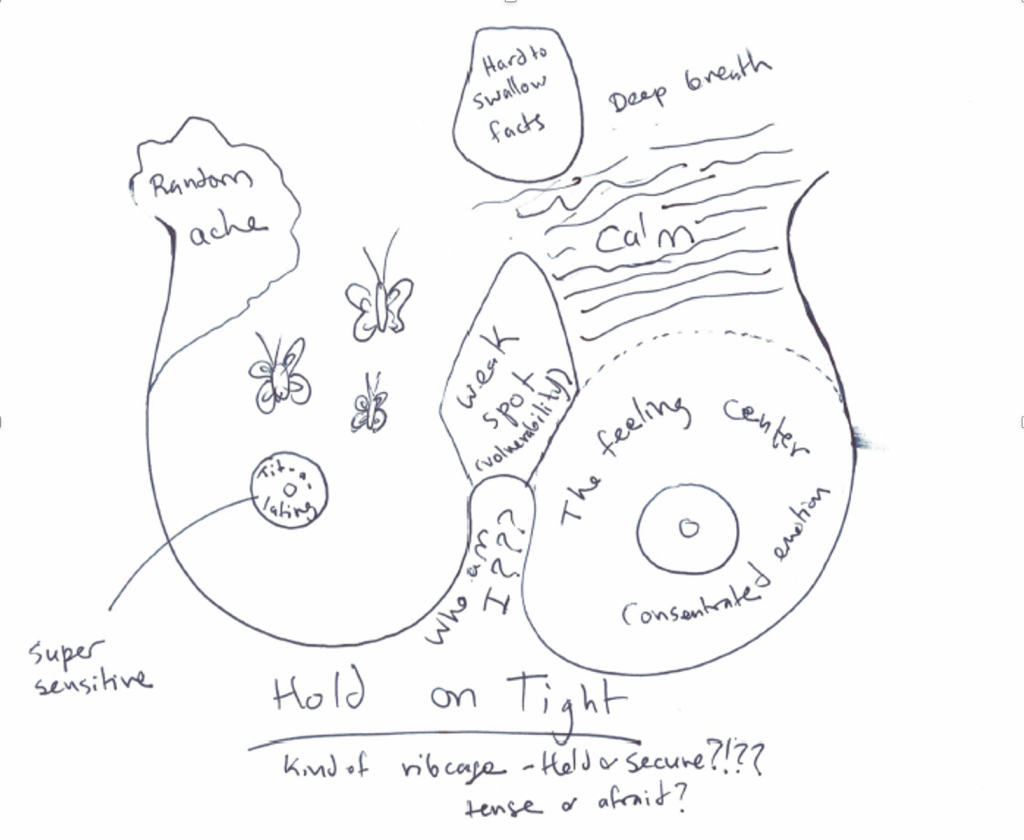
Image credit: Kathleen (Kaye) Hare
Image Description: A hand-drawn emotional map labeled “Hold on Tight,” showing curved shapes of a chest and nipples with words like “random ache,” “weak spot (vulnerability),” “calm,” and “the feeling center.” Butterflies and waves connect these areas. Notes include “Who am I???” and “Kind of ribcage – held or secure? tense or afraid?” evoking tension, reflection, and calm
Call for Proposals:
Scrapwork is a special issue that invites contributors to gather and grow something from that which is leftover, inspired by Kate Eichhorn’s (2013, 29) conceptualizing of the “feminist scrap heap.”
The scrap heap […] is not a site of refuse/refusal but a complex site where the past accumulates in the present as a resource to be embraced and rejected, mined and recycled, discarded and redeployed. As such, feminism’s scrap heap is both a site of abjection—that which must be expelled but that which we cannot live without— and simultaneously a playground, a refuge, a scene of innovation, humor, hope, and longing.
Many scholars across disciplines—critical disability studies, Mad studies, feminist theory, queer and trans studies, and those engaged in decolonizing work—also attend to the promising power of creatively and critically attending to what gets cast aside. They turn toward what is considered refuse or trash, what is lost or forgotten, and ask how meaning might emerge with and through what, and who, is sometimes discarded. In particular, we draw inspiration from an array of ideas such as Sara Ahmed’s (2019) work on the notion of use and queer use, Perry Zurn’s (2024) theorizing about dust and trans lives in universities, and Megan Sweeney’s (2023, 184) ideas about mending, which involves “close-range, ongoing emotional engagement, and extended process of coming to terms with what is broken” such that we learn to “live with fragments that never add up to a whole.”
With all this in mind, we invite short academic pieces that begin with a “scrap” from your scholarly past that stays with you in the present, because it remains some sort of feminist, critical, decolonial, or otherwise related evidence—an intriguing fragment, moment, or encounter that has lingered but hasn’t found its way into another project… and very well may not! And yet. You cannot let it go, “cannot live without” it, and know, in some way, that it is “vital rather than stagnant” (Eichhorn 2013, 29).
Drawing from Nassim Parvin et al.’s (2022, 3) work on messy feminist teaching, we think of such scraps as having a “multivalent nature that renders them flexible—trash to one person; material for use to another. Scraps can fall into cracks, get lost, or be found again.” This issue then aims to make space for those scholarly scraps to be found again, to breathe, be pondered anew, and played with, by way of creative rigour – a process we understand as scrapworking. We are guided in scrapworking by the following questions: What knowledge(s) do scraps hold? What can scraps tell us? What are we ethically called to do with the “leftovers” of research? As such, we invited you to (re) consider and contribute the following scraps:
- artworks, doodles, and scholarly scribbles
- abandoned concepts, ideas, and projects
- archival details
- classroom moments
- fieldwork fragments
- interview asides
- meaningful marginalia and/or other scholarly note-taking
- visual or sensory traces
Thinking differently about the scaffolding required for evidence to be meaningful in research output, we invite submissions for Scrapwork that are rigorous, situated, and citational, yet digestible (1000 to 4000 words or equivalent). Each piece should build from a single fragment—what we might call a forsaken piece of evidence—and think or feel with it. Authors are invited to develop that scrap into a standalone short work, to contextualize and historicize it, and return to it with analytic, creative, and/or theoretical attention and reflexivity. Through these fragments, we hope to build a record of feminist and critical inquiry that honours what we notice but can’t yet fully explain.
We welcome submissions that are creative, critical, multimodal, scholarly, speculative, somewhere in between, or intersect across these possibilities. All pieces should engage relevant feminist, queer, critical race, decolonial, Indigenous, crip, or other critical literatures or traditions. We especially encourage submissions from scholars, practitioners, artists, and those working across disciplines or from the margins of institutional research.
Proposal Submission Instructions:
- To submit, please send a 250-word abstract and 100-word biography to both guest editors, Amber Moore (amber.moore@ubc.ca) and Kaye Hare (kaye.hare@ucanwest.ca), making sure to cc Feral Feminisms at feralfeminisms[at]gmail[dot]com by January 15, 2026.
- Please prepare your submissions using Chicago author date, following the style carefully so as to show respect and cut back on labor for the volunteer editorial staff. Pieces that do not do this will not be considered or published.
- Feral Feminisms only considers submissions that are not previously published or under review at other journals. Contributors retain the copyright of their pieces under Creative Commons licensing.
Invited Full Submissions:
- Should be short form (1000–4000 words or multimodal equivalent)
- Can consist of poems, photo essays, digital collages, zines, or other multimodal formats, and or other hybrid or experimental writing forms
- Please note that all images should include access text, directly placed in the main text document where the image will appear
- Videos should also include 3 to 6 screenshots of the video, each screenshot accompanied by access text, directly placed in the main text document where the image will appear
- All text should be submitted in a Word doc
- All submissions should be prepared for peer review with no identifying markers
- Carefully follow Chicago author-date style
- For detailed submission guidelines, visit http://www.feralfeminisms.com/submission-guidelines/.
Anticipated Timeline:*
CPF for abstract closes: January 15, 2026
Editorial responses: February 15, 2026
Full pieces due: June 30, 2026
Peer reviewer feedback: Fall 2026
Edited pieces due back with guest editor: January 15, 2027
Copyediting: Winter 2027
Anticipated launch: Spring 2027
*Please note that this is the anticipated timeline only and delays are to be expected as Feral Feminisms practices a slow publishing model that does not put pressure on authors, reviewers, or journal creators to work quickly and at all costs.
About the guest editors:
Amber Moore is an Assistant Professor of Teaching in Library, Literacy, and Teacher Education at The University of British Columbia. Her research interests include: adolescent literacies; arts-based research; English education; feminist pedagogies; teacher and teacher librarian education; rape culture; and representations of youth in popular culture and YA literature, particularly sexual assault narratives. Her scholarship can be found across a number of publications such as English Journal, Feminist Media Studies, and New Review of Children’s Literature and Librarianship. Link to Scholar Profile: Click Here
Kathleen (Kaye) Hare is an Associate Professor (Interdisciplinary – Arts, Communications and Social Sciences) at University Canada West and the current co-president of Options for Sexual Health. Her research brings together sexual and reproductive health, feminist politics and pedagogies, experiential learning, knowledge exchange, and creative methodologies. Her work can be found in journals such as Sex Education, The International Journal of Qualitative Methods, and Emotion, Space and Society. She loves documentary films and writing flash non-fiction. Link to Scholar Profile: Click Here and personal website: Click Here
References
Ahmed, Sara. 2019. What’s the Use?: On the Uses of Use. Duke University Press.
Eichhorn, Kate. 2013. The Archival Turn in Feminism: Outrage in Order. Temple University Press.
Mosmann, Petra. 2016. “Encountering Feminist Things: Generations, Interpretations and Encountering Adelaide’s ‘Scrap Heap.’” Journal of Australian Studies 40 (2): 172–89.
Parvin, Nassim, Rebecca Rouse, Diana Alvarez, Sanaz Haghani, Sharon Clark, Nettrice R. Gaskins, Anne Sullivan, et al. 2022. “Mess and Making Matters in Feminist Teaching.” Catalyst: Feminism, Theory and Technoscience 8 (1): 1–44.
Sweeney, Megan. 2023. Mendings. Duke University Press.
Zurn, Perry. 2024. How We Make Each Other: Trans Life at the Edge of the University. Duke University Press.
All Worn Out in the Academy: Dreaming for Spirit-Healing Education // Abstract Deadline: Closed March 15, 2025, thank you to all who submitted
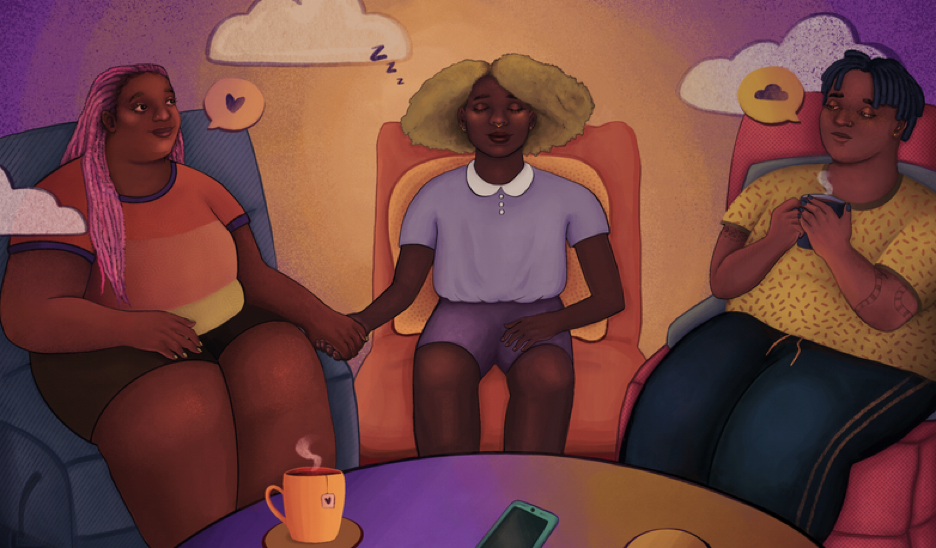
Image credit: Jonathan Soren Davidson from the Disabled and Here Collective, Creative Commons Licensed
Image description: Three Black friends sit in comfortable chairs and supportive recliners during an evening conversation. In the middle, a friend with narcolepsy falls asleep smiling while clouds drift behind her head. Her girlfriend sits to the left, holding her hand while talking to another sleepy friend across the table. This friend cups hot cocoa to their chest. Everyone is dressed in colorful t-shirts and there is cozy, warm light throughout the room.
Many of us interested in anti-oppressive education, activism, and advocacy are worn out. Our journeys to learn, pursue graduate education, and seek employment in academia, might have been propelled by a belief that theory might help us make sense of the pain we see around us (hooks 1994). However, our realities of post-secondary education have produced a type of cognitive dissonance—of learning about forms of resistance while embodying ways of knowing, being, and valuing that are not liberating at all. Universities often reproduce carceral logics like hierarchical thinking and promote white colonial ablesanist conceptions of excellence (Ahmed, 2012; Dolmage 2017; Khúc 2024; Price 2024; Wilder 2013). These logics contribute to what Lauren Berlant (2007) called “slow death,” the wearing out of certain people with less humanizing capital. Universities produce cognitive imperialism (Battiste 2013) and linguistic imperialism (Wa Thiong’o 1989), which can lead to what Patricia Williams (1987), Adrien Wing (1990), and Bettina Love (2019) call “spirit murder” or what Gust Yep (2003) calls “soul murder.” White colonial neoliberal ablesanist cisheteropatriarchal ways of teaching, evaluating, and orienting bodies through time/space all contribute to wearing out.
If you are feeling worn out, like us, we invite you to dream. Animate your ancestral and kin-ful feminist, trans, queer, cuir (Pierce, Viteri, Trávez, Vidal-Ortiz, and Martínez-Eschazábal 2021), quare (Johnson 2001), queer of colour (Ferguson 2003), anti-racist, anti-colonial/decolonial, anti-imperial, Indigenous, Black, Brown, im/migrant, Disabled, Crip, Mad community intelligences—to dream a different academia.
Editors are soliciting submissions from:
- Current graduate students
- Recently graduated scholars (within 5 years) (prioritizing those who are precariously employed)
- Those who were forced out of academia and its Ivory Tower
- Faculty, sessional, staff advisors/mentors, or independent scholars who are operating as agents of care in postsecondary institutions (prioritizing those who are precariously employed and/or junior faculty)
- Artists, dreamers, thinkers, writers, carers, resters
Please indicate in this Google form if you have previous publication experience and your affiliation to academia (if any). We also highly encourage Black, Indigenous, POC, international students on/outside Turtle Island, and im/migrant, queer/cuir, trans, disabled, Mad, Crip, Sick, and/or first-generation graduate students (especially those who have not yet published) to submit. If you feel comfortable disclosing this in your bio, we encourage you to do so.
Submissions are encouraged to address, but are not limited to, the following topics:
- The ethics of care between students, faculty, staff, broader communities, and non-human relations (e.g., land, waters, non-human animals)
- Ways to address and challenge carcerality within academia (i.e., frameworks and pedagogies)
- Frameworks of care for students experiencing linguistic displacement (i.e., ways to challenge linguistic imperialism and monolingual ideologies through translanguaging and/or raciolingusitic lenses) from post-secondary students whose language is not English
- Critical approaches to the concept of student solidarity in academic spaces
- Disabled, Mad, Sick engagements and responses to academia
- Kinship practices and ancestral work within the academic context
- Methodological and theoretical frameworks for research on care
- Pedagogical frameworks for enacting care, and its limits, in academia
Types of submissions we would especially like to see:
- Narratives, narrative inquiry
- Autobiographical, autoethnography, duoethnographic, polyethnographic pieces, etc.
- Polyphonic/multimodal papers
- Arts-based submissions (e.g., artwork, poetry, zines, photography, manifestos, etc.)
- Critical commentaries
- Conceptual papers
We encourage translanguaging and transliteration to honour ancestral and linguistic knowledge. If you intend to infuse phrases that are not English into your submission, please indicate this on the google form to support our editorial team.
Special issue contributions may include:
- Full-length academic essays (about 5000 – 7000 words)
- Shorter creative pieces or cultural commentaries (about 500 – 2500 words)
- Hybrid and artistic pieces, poetry, and creative works across media (up to 2500 words)
To submit, include the following:
- Fill out this Google form that will prompt you to:
- Identify a tentative first author (i.e., the person with whom editors will primarily correspond) and all other contributing authors (if applicable)
- Upload an in-progress abstract that is up to 250-500 words (if accepted, we will ask for a shorter abstract for the final submission)
- Include author biographies for each contributing author of up to 150 words for each person
- Indicate your IG handle for each contributing author (if you have one/want to share) and a link to your website (if you have one/want to share)
If you have any questions, reach out to any of the editors that you resonate with most. Emails are listed next to editorial bios. For detailed submission guidelines, visit http://www.feralfeminisms.com/submission-guidelines/. Please prepare your submissions using Chicago author date, following the style carefully so as to show respect and cut back on labor for the volunteer editorial staff. Please note that references are not needed at the abstract phase, unless the author wants to include them. Feral Feminisms only considers submissions that are not previously published or under review at other journals. Contributors retain the copyright of their pieces under Creative Commons licensing.
Anticipated timeline:
CPF for abstract closes: March 15, 2025
Editorial responses: April 15, 2025
Full pieces due: September 30, 2025
Peer reviewer feedback: January 2026
Edited pieces due back with guest editor: May 2026
Copyediting: July 2026
Anticipated launch: Fall 2026
About the guest editors:
Lindsay Cavanaugh is an educator, curriculum writer, poet, and Ph.D. candidate in Curriculum & Pedagogy at the Ontario Institute for Studies in Education (OISE), University of Toronto. Lindsay co-researches softness and femme crip mad educational futurities with educational advocates through a methodology called dream-mapping. She founded the OISE Care Collective in 2020, alongside other graduate students, who wanted to challenge the urgency, perfectionism, and competition that are widespread in graduate school. She is a white dis/abled lesbian femme, striving to break cycles and heal from inherited white heteropatriarchal violence from her Irish, Acadian French, and British ancestors. Email: lindsay.cavanaugh@mail.utoronto.ca
Siva Thangeswary Sivarajah is an educator, scholar, student service practitioner, and community organizer. Currently pursuing a Ph.D. at the OISE in Curriculum and Pedagogy, he focuses on Indigenous Education and Decolonization. His research uses thinai, Tamil Cangam landscape-based storytelling practices to negotiate survivance in graduate school among mad and disabled QT2SBIPOC students. He explores kathai (storytelling) —a dialectical relational narrative approach as a process of world making— imagining and creating a world we want to see. He founded the BIPOC thesis group, which is both a support and peer-learning space for BIPOC graduate students. Siva is also the communication team leader of the OISE Care Collective. Siva is an Eelam Tamil refugee living on the territory of the Huron-Wendat and Petun First Nations, the Seneca, and the Mississaugas of New Credit. Email: siva.sivarajah@mail.utoronto.ca
Claudio Jaramillo-Yanquepe is an educator, artist, and English Professor at Universidad Diego Portales in Santiago of Chile. He is also a recent graduate in Language & Literacies Education from OISE at the University of Toronto who focuses on English language curriculum, neoliberalism, and inequality. His Ph.D. examined English language instruction in secondary school Chile, positioning it as an imperialist tool that reproduces whiteness and coloniality. A visual artist and photographer, Claudio draws on both ethnographic tools and photovoice to understand student experiences of English language instruction. He has over 20 years experience as an English teacher educator and currently works with the Ministry of Education in Chile, overseeing curriculum and textbooks alignment. Claudio helped get the OISE Care Collective off the ground in its first year and supported graduate students in various ways while doing his Ph.D. He currently lives in Santiago, Chile. Email: claudio.jaramillo@alumni.utoronto.ca
Works Cited
Ahmed, Sara. On Being Included: Racism and Diversity in Institutional Life. Durham: Duke University Press, 2012.
Battiste, Marie. Decolonizing Education: Nourishing the Learning Spirit. Saskatoon: Purich Publishing, an imprint of UBC Press, 2013.
Berlant, Lauren. Cruel Optimism. Durham, NC: Duke University Press, 2011.
brown, adrienne maree. Pleasure Activism: The Politics of Feeling Good. Chico: AK Press, 2019.
Dolmage, Jay. Academic Ableism: Disability and Higher Education. Ann Arbor: University of Michigan Press, 2017.
Ferguson, Roderick A. Aberrations in Black: Toward a Queer of Color Critique. Minneapolis: University of Minnesota Press, 2003.
hooks, bell. Teaching to Transgress: Education as the Practice of Freedom (1st edition). New York. Routledge, Taylor & Francis Group, 1994.
Johnson, E. Patrick. “‘Quare’ Studies, Or (Almost) Everything I Know About Queer Studies I Learned From My Grandmother.” Text and Performance Quarterly 21, no. 1 (2001): 1–25.
Khúc, Mimi. dear elia: Letters from the Asian American Abyss. Durham: Duke University Press, 2024.
Love, Bettina L. We Want to Do More Than Survive: Abolitionist Teaching and the Pursuit of Educational Freedom. Boston: Beacon Press, 2019.
Pierce, Joseph M., María Amelia Viteri, Diego Falconí Trávez, Salvador Vidal-Ortiz, and Lourdes Martínez-Eschazábal. “Cuir/Queer Américas: Translation, Decoloniality, and the Incommensurable.” A Journal of Gay & Lesbian Studies 27, no. 3 (2021): 321–327.
Price, Margaret. Crip Spacetime: Access, Failure and Accountability in Academic Life. Durham: Duke University Press, 2024
Wa Thiong’o, Ngũgĩ. Decolonizing the Mind: The Politics of Language in African Literature. London: James Curry, 1989.
Wilder, Craig Steven. Ebony and Ivy: Race, Slavery, and the Troubled History of America’s Universities. New York: Bloomsbury Press, 2013.
Williams, Patricia J. “Spirit-Murdering the Messenger: The Discourse of Fingerpointing as the Law’s Response to Racism.” University of Miami Law Review 42, no. 1 (1987): 127–157.
Wing, Adrien Katherine. “Brief Reflections Toward a Multiplicative Theory and Praxis of Being.” Berkeley Women’s Law Journal 6, no. 1 (1990): 181–201.
Yep, Gust A. “The Violence of Heteronormativity in Communication Studies: Notes on Injury, Healing, and Queer World-Making.” Journal of Homosexuality 45, nos. 2–4 (2003): 11–59. https://doi.org/10.1300/J082v45n02_02.
CFP – Free Palestine!: Voices of Decolonization // Deadline: Rolling
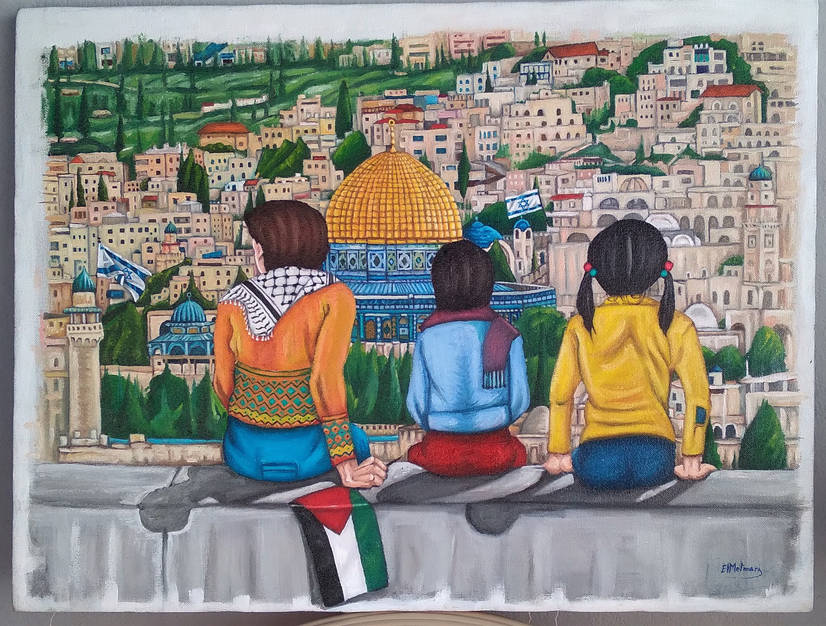
Refugees in Their Own Homeland by Mohamed El Metmari, CC licensed.
Though there has been an eruption of horrific violence in Gaza over the past weeks, this violence comes in the wake of decades of Israeli occupation, and Israeli, British, and US colonialism (Khalidi 2020). Yet the meta-narratives about this occupation have often been overwhelmingly told through the lens of Israeli officials, the IDF (Israeli “Defense” Force or as it is more adequately framed IOF – Offense Force), and their powerful allies.
This special issue focuses on responses to the ongoing violence and occupation of Palestine. Throughout the occupation of Palestine and the genocide in Gaza, the circulation of information that covers the egregious acts of violence remains cloudy and difficult to trace and verify. The violence of continuing occupation as well as the inability of journalists to tell stories from the ground has resulted in the dissemination of conflicting, misleading, and false reporting, while many news media outlets and politicians limit the terms in which Israeli-Palestinian relations can even be discussed, using Israeli-apologist language couched in terms of “conflict,” “war,” “peace,” claims of anti-semitism, and blatant Islamophobia. Much of the coverage of the genocide of Palestinian people has been documented through social media by journalists such as @motaz_azaiza and @aymanalgedi12, and many other Palestinians, who risk their lives remaining in Gaza under extremely dangerous circumstances.
This CFP invites short responses (of around 500 to 3000 words) to existing cultural content on the ongoing genocide in Gaza and the occupation of Palestine. Submissions can be in the form of short essays, reflections, visual art, poetry, creative nonfiction, multimedia, sound, video, interviews, or a combination thereof, and will be reviewed on an ongoing basis. Submissions will not be peer-reviewed but will be read carefully by our editorial team.
Submissions might consider the following themes:
- The “fog of war” or the “information war”
- Pinkwashing and co-opting of LGBTQ language by Israel
- Disability justice and genocide
- Queer liberation and Palestine
- The destruction of Land, bodies, culture, and non-human kin
- Petrocultures and occupation of Gaza
- Social media and alternative forms of reporting or information dissemination
- Responses to specific news stories/coverage
- Highlighting of specific events
- Discussions of settler colonization and decolonization efforts
- Cultural content creation by Palestinians and their allies
- Poetry, art, music, dance, and research as intervention
- Government and official and state-backed rhetoric on the violence by world leaders
- Censorship of pro-Palestinian views (particularly Canadian, US, German, and Western European censorship)
- Journalistic and editorial standards and rhetorics that limit and dictate language choice and occlude genocide, apartheid, and occupation through use of so-called “neutral” and absolving language
- Celebrity responses
- Censorship by and at universities
- Solidarity, coalition, and reparations
- Indigenous, Black, Muslim, Of Color, and Jewish solidarity with Palestine
- Police and military enforcement and arms manufacture between the US, Israel, and other nations
- Masculinity, femininity, childhood, and genocide in Gaza, the West Bank, and in representations thereof
- Boycott, Divestment, and Sanctions
- Children’s literature on Palestine and the attack on Palestinian childhood
- Transnational networks of support and resistance
Contributors are encouraged to engage with Palestinian-authored and -allied content, including social media, journalism, art, literature, film, and theory, including but not limited to the following:
- Books and resources listed here by @palipunk
- Books and resources listed by Librarians and Archivists with Palestine: https://librarianswithpalestine.org/archives-syllabus/
- Queers in Palestien statement: https://queersinpalestine.noblogs.org/post/2023/11/19/no-pride-with-genocide/
- Pluto Press reading list: https://www.plutobooks.com/free-palestine-reading-list/
- Verso Books reading list: https://www.versobooks.com/en-gb/blogs/news/5078-palestinian-solidarity-reading-list
- Haymarket Books reading list: https://www.haymarketbooks.org/blogs/71-free-palestine-a-reading-list
- The Hundred Years’ War on Palestine by Rashid Khalidi
- Things You May Find Hidden in My Ear by Mosar Abu Toha
- Queer Palestine and the Empire of Critique by Sa’ed Atshan
- Palestine: A Four Thousand Year History by Nur-eldeen Masalha
- Palestinian Identity by Rashid Khalidi
- Fragmented Bodies “Dancing on the Spot:” The Transnational Lives of Canadian Muslims and the Limits of Anti-Islamophobia Advocacy by Wafaa Hasan and Zarah Khan
- We Are Not Here to Be Bystanders: A Memoir of Love and Resistance by Linda Sarsour
- Against the Loveless World by Susan Abulhawa
- The Twenty-Ninth Year by Hala Alyan
- The Parisian by Isabella Hammad
- Israel/Palestine and the Queer International by Sarah Schulman
- Greater than the Sum of Our Parts: Feminism, Inter/Nationalism and Palestine by Nada Elia
- You Exist Too Much by Zaina Arafat
- Orientalism by Edward Said
- Israeli Apartheid: A Beginner’s Guide by Ben White
- One State by Ghada Karmi
- Settler Colonialism: An Introduction by Sai Englert
- Boycott, Divestment, Sanctions by Omar Barghouti
- Hostile Homelands: The New Alliance Between India and Israel by Azad Essa
- Freedom is a Constant Struggle by Angela Davis
- Hollow Land by Eyal Weizman
- Men in the Sun by Ghassan Kanafani
- The Presence of Absence: A River Dies of Thirst by Mahmoud Darwish
- My Garden Over Gaza by Sarah Musa
- They Called me a Lioness: A Palestinian Girl’s Fight for Freedom by Dena Takruri, Ahed Tamimi
- Sitti’s Bird: A Gaza Story by Malak Mattar
- You are the Color by Rifk Ebeid, Hajera Khaja, and Noor Alshalabi
- Sitti’s Olive Trees by Ndaa Hassan Soumbai Qureshi
- These Olive Trees by Aya Ghanameh
- Sitti’s Key by Sahar Khader Ali and Noor Alshalabi
- Colours of Al-Quds by Jenny Molendyk Divleli
- Homeland: My Father Dreams of Palestine by Hannah Moushabeck
- Baba, What does my Name Mean? By Rifk Ebeid and Lamaa Jawhari
CFP Issue 16 – Autistic A/Genders, A/Sexualities, and A/Socialities – Bilingual English + French Issue // Abstract Deadline: Closed
French version to follow.

Multicolor autistic infinity symbol upon a checkered yellow-orange background. Three zones of text respectively say “a special issue of Feral Feminisms edited by Ombre Tarragnat,” “Autistic A/Genders, A/Sexualities, and A/Socialities,” and “abstracts due December 31, 2024 / in English, French, or both.”
In the summer of 2024, US billionaire Elon Musk declared that his trans daughter, who “was born gay and slightly autistic,” was turned trans by the “woke mind virus.” For some years now, anti-trans politics have been portraying autistics as victims to trans and queer activism, displaying a form of externality between autism and transness which effectively silences autistic voices (Yergeau 2018) and erases the fundamental queerness of many autistic lives.
This special issue is set against such erasure of autistic subjects from trans and queer cultures and activisms, including by LGBT communities themselves. Drawing on respectability politics and ableist rhetoric (such as “terminally/chronically online,” “snowflake” etc.), there has been a trend of opposing assimilable LGBT subcultures and communities to abject and unreasonable queer ones, which often stem from autistic positions (Hillier 2020).
The targeting of queer and trans individuals in the West by neoliberal agendas has indeed been pressurizing queer and trans activism to synch and orient according to national and capitalist priorities (Bassi and LaFleur 2022). Queer-normative and trans-normative narratives, focused on the performance of whiteness, productivity, and neurotypicality, thus too often position the autistic embodiment of a/gender, a/sexuality, and a/sociality as a problem for queer and trans citizenship and belonging (Pyne 2021).
Yet numerous studies, mostly from a medical and pathologizing perspective, have shown the overrepresentation of autistic people among queer communities (Hermann et al. 2022;Janssen, Huang and Duncan 2016; Strang et al. 2014; Warrier et al. 2020). Many autistics themselves describe a diversity of forms of dis/identification with gender, sexuality, and sociality, which opens up a field of proliferation and experimentation beyond both straight-normative and queer-normative life paths (Cavar and bougie 2024).
Rather than focusing only on the critique of neoliberal and neofascist rhetoric, this issue attempts to narrate, figure, and speculate about the subversive creativity emanating from autistics. While thinking beyond identity politics, it seeks to understand how individual and collective autistic practices move within and constitute larger queer and trans communities, subcultures, and performances, even if traveling under different signs.
For this special issue, we especially invite submissions by autistic researchers and by contributors who center the first-hand experience of autistic people. Different regimes of thinking and writing stemming from autistic situated knowledges, like autistethnography (Grace 2013), autistic autobiography, speculative and literary fabulation of neuroqueer utopias (Reichart et al. 2021; Stannard Ashley 2024), are welcome, along with more classical regimes, like the history and sociology of autistic communities, or queer and feminist theorizing of autism. In line with the focus on autistic lives in their diversity and complexity, contributions might address the role of other forms of neurodivergence in autistic subcultures and practices. Contributions thinking with and on the experience of Black, Brown, Indigenous, and non-Western authors are also especially welcome.
Contributions that explore these and other lines of inquiry are warmly invited:
- Non-normative autistic experiences and performances of a/gender and identity
- Autigenders
- Xenogenders
- Fascigenders
- Transautism and becoming-autistic
- Forms of queer dis/identification
- Autistic bodily aesthetics and gender expression
- Autistic labelings of a/gender identities
- Autism and gender norms
- Non-normative autistic experiences and performances of a/sexuality and eroticism
- Autistic sex
- Autoeroticism
- Open relationships
- Ecosex and multispecies pleasures
- Object-oriented eroticism
- Asexuality and queerplatonic partnerships
- Subversive and pleasurable somatic practices by autistics, like stimming, unmasking, dancing
- Non-normative autistic experiences and performances of a/sociality and kinship
- Online relationships, friendships, and activism
- Autistic queer and trans life paths
- Autistic parenthood and childhood
- Queer relational and anti-relational readings of autistic lives
- Historical and contemporary autistic figures and communities in queer and trans activism
- More-than-human care and kinship with nonhuman animals, plants, minerals, objects, environments
Submission Instructions:
Special issue contributions may include:
- Full-length theoretical essays (5000 – 7000 words)
- Shorter creative pieces, cultural commentaries, personal narratives, or autistethnographies (500 – 2500 words)
- Poetry, photo-essays, short films/video, visual and sound art, or a combination of forms.
- All contributions can be made in either English, French, or both.
To submit, please send a 250-word abstract and 100-word biography to guest editor Ombre Tarragnat at ombre.tarragnat[at]gmail[dot]com by December 31, 2024, making sure to cc Feral Feminisms at feralfeminisms[at]gmail[dot]com.
For detailed submission guidelines, visit http://www.feralfeminisms.com/submission-guidelines/. Please prepare your submissions using Chicago author date, following the style carefully so as to show respect and cut back on labor for the volunteer editorial staff. Feral Feminisms only considers submissions that are not previously published or under review at other journals. Contributors retain the copyright of their pieces under Creative Commons licensing.
Anticipated timeline:
CFP for abstracts closes: December 31, 2024
Editorial responses: January 31, 2025
Full pieces due: June 2025
Peer Review: July to October 2025
Edited pieces due back with guest editor: December 2025
Copyediting: January to March 2026
Anticipated Launch: Spring/Summer 2026
About the Guest Editor
Ombre Tarragnat (they/she) is a PhD student in Gender Studies and Philosophy at the Laboratoire d’Études de Genre et de Sexualité (LEGS), enrolled at Université Paris 8 Vincennes Saint-Denis where they work on a project entitled “Autism as Ethodivergence: Philosophical Ethology, Posthumanism, Phenomenology,” situated at the intersection of autism and animality.
AAC numéro 16 – A/Genres, A/Sexualités et A/Socialités Autistes – Numéro bilingue anglais + français // Date limite de dépôt des résumés : 31 décembre 2024

Symbole autiste infini multicolore sur un arrière-plan à carreaux jaune-orange. Trois zones de texte disent respectivement “un numéro spécial de Feral Feminisms édité par Ombre Tarragnat,” “A/Genres, A/Sexualités et A/socialités Autistes” et “date limite de dépôt des résumés / 31 décembre 2024 / en anglais, français ou les deux.”
Pendant l’été 2024, le milliardaire étatsunien Elon Musk déclarait que sa fille trans, « né [sic] gay et légèrement autiste », était devenue trans à cause du « virus de la pensée woke ». Depuis maintenant quelques années, les politiques anti-trans représentent les autistes comme des victimes de l’activisme trans et queer, affichant une sorte d’externalité entre l’autisme et la transitude qui revient à silencier les voix autistes (Yergeau 2018) et effacer la queerness fondamentale de nombreuses vies autistes.
Ce numéro spécial se positionne contre un tel effacement des sujets autistes des cultures et activismes trans et queer, notamment par les communautés LGBT elles-mêmes. S’appuyant sur des politiques de respectabilité et une rhétorique validiste (par ex. « terminally/chronically online » ou « snowflakes »), on observe une tendance à opposer des subcultures et communautés LGBT assimilables à d’autres, queer, jugées abjectes et déraisonnables, qui découlent souvent de positions autistes (Hillier 2020).
Le ciblage des individus queer et trans par les agenda néolibéraux en Occident met en effet la pression sur l’activisme queer et trans pour que celui-ci se synchronise et s’oriente selon des priorités nationalistes et capitalistes (Bassi et LaFleur 2022). Les récits queernormatifs et transnormatifs, en se concentrant sur la performance de la blanchitude, de la productivité et de la neurotypicalité, positionnent ainsi trop souvent l’incarnation autiste de l’a/genre, de l’a/sexualité et de l’a/socialité comme un problème pour la citoyenneté et l’appartenance queer et trans (Pyne 2021).
Pourtant, et d’abord depuis une perspective médicale et pathologisante, de nombreuses études ont démontré la surreprésentation des personnes autistes au sein des communautés queer (Hermann et al. 2022;Janssen, Huang and Duncan 2016; Strang et al. 2014; Warrier et al. 2020). De nombreux·ses autistes elleux-mêmes décrivent une diversité de formes de dés/identification avec le genre, la sexualité et la socialité, ce qui ouvre un champ de prolifération et d’expérimentation qui échappe aux trajectoires de vie aussi bien hétéronormatives que queernormatives (Cavar et bougie 2024).
Plutôt que de se concentrer uniquement sur la critique de la rhétorique néolibérale et néofasciste, ce numéro vise à narrer, figurer et spéculer sur la créativité subversive émanant des autistes. Tout en réfléchissant au-delà des politiques de l’identité, il cherche à comprendre comment les pratiques autistes individuelles et collectives s’inscrivent dans des communautés, subcultures et performances queer et trans plus larges et les constituent, même si elles se déploient parfois sous des signes différents.
Pour ce numéro spécial, nous invitons tout particulièrement des propositions faites par des chercheur·euses autistes et des contributeur·ices qui placent l’expérience directe des personnes autistes au centre. Différents régimes de pensée et d’écriture issus des savoirs situés autistes, comme l’autistethnographie (Grace 2013), l’autobiographie autiste, la fabulation spéculative et littéraire d’utopies neuroqueer (Reichart et al. 2021; Stannard Ashley 2024) sont bienvenues, aux côtés de régimes plus classiques, comme l’histoire et la sociologie des communautés autistes, ou la théorisation queer et féministe de l’autisme.
Conformément à l’accent mis sur les vies autistes dans leur diversité et leur complexité, les contributions pourraient aborder le rôle d’autres formes de neurodivergence dans les subcultures et les pratiques autistiques. Les contributions portant sur et partant de l’expérience d’auteur·ices noir·es, autochtones et non occidentaux sont également particulièrement bienvenues.
Les contributions qui explorent (entre autres) ces lignes de recherche sont vivement souhaitées :
- Expériences et performances autistes non-normatives de l’a/genre et de l’identité
- Autigenres
- Xénogenres
- Fascigenres
- Transautisme et devenir-autiste
- Formes de dés/identification queer
- Esthétiques autistes du corps et de l’expression de genre
- Dénominations autistes des identités de genre/agenre
- Autisme et normes de genre
- Expériences et performances autistes non-normatives de l’a/sexualité et de l’érotisme
- Sexe autiste
- Autoérotisme
- Relations libres
- Écosexe et plaisirs multi-espèces
- Érotisme orienté objet
- Asexualité et partenariats queerplatoniques
- Pratiques somatiques subversives et sources de plaisir chez les autistes, comme le stim, le décamouflage, la danse, etc.
- Expériences et performances autistes non-normatives de l’a/socialite et de la parenté
- Relations, amitiés et activisme en ligne
- Trajectoires de vie autistes queer et trans
- Parentalité et enfance autistes
- Lectures queer relationnelles et anti-relationnelles des vies autistes
- Figures et communautés autistes historiques et contemporaines dans l’activisme queer et trans
- Care et parenté plus-qu’humain·es avec les animaux non-humains, les plantes, les minéraux, les objets, les environnements
Instructions pour les contributions
Les contributions au numéro spécial peuvent inclure :
- Des essais théoriques longs (5000 – 7000 mots)
- Des textes créatifs plus courts, commentaires culturels, récits personnels ou autistethnographies (500 – 2500 mots)
- Poésie, essais-photo, films/vidéos courtes, art visuel et sonore, ou une combinaison de formes.
- Toutes les contributions peuvent être préparées en anglais, en français, ou dans les deux langues.
Pour soumettre une proposition, veuillez envoyer un résumé de 250 mots et une biographie de 100 mots à l’éditeur·ice invité·e Ombre Tarragnat à ombre.tarragnat[arobase]gmail.com d’ici au 31 décembre 2024, en prenant soin d’ajouter Feral Feminisms en cc à feralfeminisms[arobase]gmail.com.
Pour des directives détaillées concernant les contributions, consultez le site http://www.feralfeminisms.com/submission-guidelines/. Veuillez préparer vos contributions à partir du style Chicago auteur-date, que nous vous demandons de suivre scrupuleusement de manière à faire preuve de respect et à réduire la charge de travail de l’équipe éditoriale bénévole. Feral Feminisms ne prend en compte que les articles qui n’ont pas été publiés antérieurement ou qui ne sont pas en cours d’évaluation dans d’autres revues. Les contributeur·ices conservent les droits d’auteur de leurs articles sous licence Creative Commons.
Calendrier prévu
L’AAC pour les résumés ferme : 31 décembre 2024
Réponses éditoriales : 31 janvier 2025
Rendu des textes complets : juin 2025
Examen par les pairs : juillet à octobre 2025
Rendu des textes révisés auprès de l’éditeur·ice invité·e : décembre 2025
Relecture-correction : janvier à mars 2026
Sortie prévue du numéro : printemps/été 2026
À propos de l’éditeur·ice invité·e
Ombre Tarragnat (iel/elle) est doctorant·e en études de genre et philosophie au Laboratoire d’Études de Genre et de Sexualité (LEGS), rattaché à l’Université Paris 8 Vincennes Saint-Denis, où iel travaille sur un projet intitulé “L’autisme comme éthodivergence. Éthologie philosophique, posthumanisme, phénoménologie” situé à l’intersection de l’autisme et de l’animalité.
Works Cited
Bassi, Serena, and Greta LaFleur. 2022. “Introduction: TERFs, Gender-Critical Movements, and Postfascist Feminisms.” Transgender Studies Quarterly 9, no. 3: 311–333. https ://doi.org/10.1215/23289252-9836008
Cavar, S., and ulysses/constance bougie. 2024. “port-man-toes: the aroace – queercrip – transmad – neuroqueer erotics of digital collaboration.” Kairos: A Journal of Rhetoric, Technology, and Pedagogy 28, no. 2. Retrieved July 17, 2024, from http://kairos.technorhetoric.net/28.2/topoi/cavar-bougie/index.html.
Grace, Elizabeth J. 2013. “Autistethnography.” In Both Sides of the Table: Autoethnographies of Educators Learning and Teaching with/in [Dis]ability, edited by Phil Smith,89–101. New York: Peter Lang.
Hermann, Lea, Ai Baba, Deniz Montagner, Rebecca Parker, Joseph A. Smiga, Sig Tomaskovic-Moore, Aria Walfrand, Tristan L. Miller, Robin Weis, Caroline Bauer et al. 2022. 2020 Ace Community Survey Summary Report. The Ace Community Survey Team. https://acecommunitysurvey.org/2022/10/27/2020-ace-community-survey-summary-report/.
Hillier, Ashleigh, Nicholas Gallop, Eva Mendez, Dylan Tellez, Abigail Buckingham, Afreen Nizami, and Derek OToole. 2020. “LGBTQ + and Autism Spectrum Disorder: Experiences and Challenges.” International Journal of Transgender Health. 21, no. 1: 98–110. https://doi.org/10.1080/15532739.2019.1594484.
Janssen, Aron, Howard Huang, and Christina Duncan. 2016. “Gender Variance Among Youth with Autism Spectrum Disorders: A Retrospective Chart Review.” Transgender Health 1, no. 1: 63–68. https://doi.org/10.1089/trgh.2015.0007.
Pyne, Jake. 2021. “Autistic Disruptions, Trans Temporalities: A Narrative ‘Trap Door’ in Time.” South Atlantic Quarterly. 120, no. 2: 343–361. https://doi.org/10.1215/00382876-8916088.
Reichard, Andrew M., Dora M. Raymaker, and Nick Walker. 2021. Spoon Knife 5: Liminal. Fort Worth: Autonomous Press.
Stannard Ashley, Abs. 2024. “Neuroqueering Gender/Genre: Autistic Storying in Contemporary Anglophone Literatures.” PhD diss., Bristol Doctoral College.
Strang, John F., Lauren Kenworthy, Aleksandra Dominska, Jennifer Sokoloff, Laura E. Kenealy, Madison Berl, Karin Walh, Edgardo Menvielle, Graciela Slesaransky-Poe, Kying-Eun Kim et al. 2014. “Increased Gender Variance in Autism Spectrum Disorders and Attention Deficit Hyperactivity Disorder.” Archives of Sexual Behavior. 43, no. 8: 1525–1533. https://doi.org/10.1007/s10508-014-0285-3.
Warrier, Varun, David M. Greenberg, Elizabeth Weir, Clara Buckingham, Paula Smith, Meng-Chuan Lai, Carrie Allison, and Simon Baron-Cohen,2020. “Elevated Rates of Autism, Other Neurodevelopmental and Psychiatric Diagnoses, and Autistic Traits in Transgender and Gender-Diverse Individuals.” Nature Communications, 11, no. 1. https://doi.org/10.1038/s41467-020-17794-1.
Yergeau, Remi. 2018. Authoring Autism: On Rhetoric and Neurological Queerness. Durham: Duke University Press.
CFP Issue 15 – BLACK BRITISH FEMINISMS AND PERFORMANCE // Abstract Deadline: Closed

Image by Hulki Okan Tabak from Pixabay.
A decade of austere and xenophobic rhetoric has culminated in a “hostile environment” in Britain that attempts to restrict access to public spaces and services of public interest for people who are minoritised by, race, gender, and sexuality. For Black British feminists, creativity remains an important tool for resisting the past, present and, futures of these oppressions in British spaces (Gayle 2020).
This special issue aims to explore the ways in which Black British women, cis and trans, use performance, be that through music, theatre or other creative art forms, to respond to the silencing and erasure that they experience. Through performance, Black women can vocalise their grievances, affirm their presence, and articulate their reality (Bryan, Dadzie and Scafe 2018; Mosley 2021). For some Black women, performance generates space to evoke a Black aesthetic which makes visible ways to live through struggle (Smalls and Powell 2019). In this way, performers engage with issues of race, space, and place to reclaim Black women’s past, present and futures in often hostile British spaces. This “feminist work” explores and illustrate ways that Black women are positioned by racist and heterosexist discourses (Goddard 2007).
For this special issue on “Black British feminisms and performance”, guest editors Parise Carmichael-Murphy and Lorna French, invite contributors to celebrate performance as part of Black women’s “intellectual production” (Nash 2018). In response to Christina Sharpe’s (2016) call to become “undisciplined,” this special issue will lean into ways that Black British feminisms are, and have been, expressed through performance to resist legibility and affirm Black women’s lives in Britain. This is evident in the ways that Black women singers, playwrights, MCs, poets, dancers, and other performers challenge the silences imposed on them, ultimately working to make their experiences audible, visible, or felt.
The guest editors welcome contributors that explore ways that performance can hold space for Black women’s embodied experience and discursive resistance. We encourage contributors to submit shorter creative pieces or cultural commentaries that may provoke or intervene. Contributors are also encouraged to mess with disciplinarity and submit pieces that blur the lines between the arts, humanities, and social sciences. Therefore, in addition to full length articles of no more than 7000 words, we welcome up to 3000-word contributions of: poetry and prose, interviews or “in conversations,” media reviews, collages and artwork, annotated playlists and lyrics, short cultural commentaries, photo-essays, visual and sound art, short films, or a combination of these. We welcome submissions from students, artists, activists, cultural creators, and established academics.
Topics for exploration might include:
- Black British feminisms and resistance in music, theatre, and literature
- Resistance of dominant discourse by playwrights, theatre makers, musicians and songwriters
- Constructions of Black British identity and Black British feminisms through performance
- Creative responses to attempts to silence or erase Black British women and feminisms
- Black women’s strategies for affirming their place in hostile British spaces
- Expressions of Black womanhood and Black British feminism
- Imaginative and creative outputs that disturb the boundaries of racialised sexuality and gender
To submit, please send a 250-word abstract and 100-word biography to guest editors Parise Carmichael-Murphy and Lorna French at BBFandPerformance[at]gmail.com by April 1, 2024, making sure to cc Feral Feminisms at feralfeminisms[at]gmail.com.
For detailed submission guidelines, visit http://www.feralfeminisms.com/submission-guidelines/. Please prepare your submissions using Chicago author date, following the style carefully so as to show respect and cut back on labor for the volunteer editorial staff. Submissions that do not carefully follow this style will not be considered out of consideration for volunteer-based editorial staff. Feral Feminisms only considers submissions that are not previously published or under review at other journals. Contributors retain the copyright of their pieces under Creative Commons licensing.
Anticipated timeline:
CFP for abstracts closes: April 1, 2024
Editorial responses: May 2024
Full pieces due: October 2024
Peer Review: October to February 2025 (estimated)
Edited pieces due back with guest editors: June 2025
Copyediting: June and July 2025
Launch: late Summer/Fall 2025
About the Guest Editors:
Parise Carmichael-Murphy is completing a PhD in Education at the University of Manchester. She is a member of the Feminist Review editorial collective, and is passionate about celebrating Black British feminisms, identity, music, and culture. She is @Parise_CM on X (formerly Twitter).
Lorna French is completing her PhD in Drama and Theatre Arts at the University of Birmingham. She is a playwright who won the Alfred Fagon Award in 2006 and 2016. Lorna is committed to exploring Black British feminisms, race, gender, playwriting, and dramaturgy. She is @LornaFr on X (formerly Twitter).
References
Bryan, Beverley, Stella Dadzie, and Suzanne Scafe. 2018. Heart of the Race: Black Women’s Lives in Britain. London: Verso.
Gayle, Rita. 2020. “Creative Futures of Black (British) Feminism in Austerity and Brexit Times.” Transactions of the Institute of British Geographers 45, no. 3: 525–528.
Goddard, Lynette. 2007. Staging Black Feminisms: Identity, Politics, Performance. Basingstoke & New York: Palgrave Macmillan.
Mosley, Angela M. 2021. “Women Hip-Hop Artists and Womanist Theology.” Religions 12, no. 12: 1063.
Nash, Jennifer C. 2018. Black Feminism Reimagined: After Intersectionality. Durham: Duke University Press.
Sharpe, Christina. 2016. In the Wake: On Blackness and Being. Durham: Duke University Press.
Smalls, Shanté P, and Elliot H. Powell. 2019. “Introduction: an ImPossibility: Black Queer and Trans* Aesthetics.” The Black Scholar 49, no. 1: 1–5.
CFP Issue 14 – Feminist Forms of Submission // Abstract Deadline: Closed

As a submissive lesbian and textile artist whose arts practice and research is rooted in exploring queer BDSM, kink dynamics, queer identity, and their intersection with feminisms, I consistently come across the question, “how can people who identify as submissive (or a sub) also be feminist?”
There are a lot of misconceptions about the kink community in general; “BDSM is still, whether explicitly stated or quietly believed, regularly assumed to be sick, freaky, deviant, wrong…” (Scott 2015, 12). These misconceptions are especially disseminated by anti-sex positive narratives and ideologies, which attempt to perpetuate the idea that women-identifying and gender non-conforming submissives have somehow been coerced into submission by trying to paint “an exposé of exploitation, abuse, and objectification” (Rosewarne 2011, 167).
However, this limited understanding of submission is the furthest from the truth. Holistic Dom(me)/sub dynamics are based on ongoing consent, communicated and respected boundaries, and the exploration of pleasure for all parties involved. Kink is an act of queering sex “since it ritualizes modern gays and lesbians into a transgressive transaction that is about ecstasy and ruin” (Geczy and Karaminas 2013, 99). The study of BDSM and kink are, therefore, inherently queer ways of engaging in intimacy and critically exploring queer sexuality studies. BDSM and kink are also deeply embedded in queer culture and identity, such as the queer leather community. Ariane Cruz furthers this from both a queer theory and Black feminist theory lens, discussing how BDSM and pornography are an expression of “the power, agency, and pleasure, albeit highly conflicted, that they engender for black women” (Cruz 2016, 20).
The goal of this special issue is to uplift and represent a true understanding of submission and create more accurate representations of submission in the face of current misunderstandings that academia and mainstream culture have of the queer kink community. For this special issue on “Feminist Forms of the Submission” the guest editor, Deanna Armenti, invites explorations of submission as it relates to or interacts with a variety of themes, which may include (but are not limited to):
- Decolonizing and Indigenous approaches to submission
- Critical race perspectives on femininity and submission
- Postcolonial theory and femininity and submission
- Practice-based, interdisciplinary expressions of submission, kink, and BDSM
- Submission as a spiritual, intimate personal and interpersonal experience
- Experiences and thoughts on subspace
- Auto-ethnographic and personal experiences with submission and being a sub (submissive)
- Queer subs/submission, kink/BDSM experiences
- Gender expression and submission (non-binary, gender fluid, gender non-conforming, and trans experiences)
- Affect and embodiment theory intersecting with Queer Studies and kink/BDSM
Submission Instructions:
Special issue contributions may include:
- Full-length theoretical essays (5000 – 7000 words max)
- Shorter creative pieces, cultural commentaries, personal narratives, or auto-ethnographies (500 – 2500 words)
- Poetry, photo-essays, short films/video (uploaded to Vimeo), visual (jpeg) and sound art, or a combination of forms.
To submit, include the following:
- 100-word abstract on a Word document by October 15th, 2023
- 60-word author biography on a separate Word document, including your IG handle (if you have one/want to share) and a link to your website (if you have one/want to share)
- Please send abstracts and inquiries to guest editor Deanna Armenti at deanna[dot]armenti[at]torontomu[dot]ca, making sure to cc Feral Feminisms at feralfeminisms[at]gmail[dot]com
- For detailed submission guidelines, visit http://www.feralfeminisms.com/submission-guidelines/. Please prepare your submissions using Chicago author date, following the style carefully so as to show respect and cut back on labor for the volunteer editorial staff. Submissions not closely following Chicago author-date cannot be considered.
- Feral Feminisms only considers submissions that are not previously published or under review at other journals. Contributors retain the copyright of their pieces under Creative Commons licensing.
Anticipated Submission Timeline:
- Abstract Due Date: October 15th, 2023
- 1st Draft Due Date: January 31st, 2024
- Final Draft Due Date: Summer 2024
About the Guest Editor:
Deanna Armenti (She/Fae) is a Queer Genderfae poet, zine creator, and textile researcher. Deanna recently completed the Fashion Master’s program at Toronto Metropolitan and will be continuing at TMU in the Media and Design Innovation PhD program having received the Ontario Graduate Scholarship for her first year of study.
Deanna’s research is practice-based and explores queer, kink identities through the lens of embodiment and affect to investigate the queer erotic form. She seeks to combat the pathologization and stigmatization of the queer kink community through demystifying the lifestyle. Her creation of accessible material installations is an embodied practice which invites folks to engage with the community. Deanna’s research focuses on queer temporalities, seeking liminal spaces and ‘slices in time’ as a means of conveying the non-linear spectrum of queerness. She also explores the community’s use of signaling as semiotics, investigating alternate forms of communication such as sign based discourse.
Deanna has editorial assistant experience, having worked with the open access journal Fashion Studies during her Master’s degree. Her article “Subspace: An Internal and Liminal Place” is currently under review for Volume 5, Issue 1 of Fashion Studies. Deanna also curates her own publication, The Sapphic Printing Press, which publishes queer writers worldwide in a collaborative zine called SAPPHIC. Her creative writing has received publication in zines such as Feels Zine, Carousel Collective, and Sinister Wisdom. Her poetry zine I Know My Own Heart was nominated for best Litzine at the Broken Pencil 2022 zine awards.
References
Cruz, Ariane. 2016. The Color of Kink: Black Women, BDSM, and Pornography. New York: New York University Press.
Geczy, Adam, and Vicki Karaminas. 2013. Queer Style. London: Bloomsbury Education.
Rosewarne, Lauren. 2011. Part-Time Perverts: Sex, Pop Culture, and Kink Management. London: Bloomsbury.
Scott, Catherine. 2015. Thinking Kink: The Collision of BDSM, Feminism and Popular Culture. Jefferson, NC: McFarland Books.
CFP Issue 13 – Excess: The Intersections of Critical Femininities, Mad Studies, and Critical Disabilities // Abstract Deadline: Closed
“Excess” has been conceptualized in various ways: it is the grammar of camp style; the signifier of capitalism; the name of inequality; and a warning of environmental collapse. “Excess” is the abject and the affective—those feelings, affects and embodiments that “spill over,” which exceed white supremacist, heteropatriarchal, ableist, sanist, and cissexist frameworks of recognition or normative logics of acceptability. Queer and racialized sexualities, bodies, knowledges, and affects are read as “too much”—hypersexualized, objectified, and pathologized (Albrecht-Samarasinha, 1997; Allen, 1992; Collins, 2005; Musser, 2018; Nestle, 1992); white bodies are marked as Other, as excessive, when they gain weight, have queer sex, or act without middle-class decorum (Brown, 2005; Dominguez, 2015; Walker, 2001). Insofar as femininity, and femme, are excessively embodied, excessively artificial, and excessively emotional, “excess” is the charge against femininity—and some femininities more than others. We contend that a critical femininities framework—which moves beyond accounts of femininity as a site of patriarchal control to unhinge femininity from “woman” and “female” and understand the feminine as a site and form of knowledge (Dahl 2012)—foregrounds the ways that “excess” and practices of exceeding are mobilized by marginalized communities as strategies of resistance, survival, and celebration, including “brown jouissance” (Musser 2018) and “queer of color camp” (Dominguez 2015). A critical femininities framework can be mobilized to frame the politics of excess as potentially emancipatory, opening up the possibilities of queer femme futurities, pleasures, protests, and practices of care (Brushwood Rose & Camillieri 2002; Dawson 2017; Hollibaugh 2000; McCann 2018; Nestle 1992; Schwartz 2016, 2018, 2020; Volcano & Dahl 2008).
Simultaneously, “excess” is weaponized as pathology and immorality against historically marginalized groups, including women, queers, the disabled, Mad, and racialized (Russo 1995; Skelly 2014; Musser 2018). Jane Skelly writes that “like decadence, the term ‘excess’ has often been used to shame and/or control that which threatens the social order” (2018, 4): the excessively embodied, excessively emotional, and excessively abject—those traits so closely and consistently reified as feminine and Mad—only exist in relation to the norms they transgress (Russo 1995; Skelly 2014; Skelly 2018). Situating an intersectional critical femininities framework in conversation with Mad and critical disability scholarship invites new engagements with the pathologization of feminized forms of Madness and psychiatric disabilities (Chesler 2005; Johnson 2015, 2021; Kafai 2013, 2021; Mollow 2006, 2014; Shaw and Proctor 2005; Showalter 1987; Ussher 1992) and highlights potential scholarly and activist coalitions between Mad studies and femme theory. We invite examinations of the possibilities and limits of a framework of “excess” through the lenses of critical femininities, Mad studies, and critical disabilities. To render “excess” a theoretical terrain of analysis also invites scholarly coalitions between Mad studies, femme theory, racialization, and, for example, Blackness (Bruce 2021; Pickens 2019).
For this special issue on “Excess,” the guest editors Andi Schwartz and Shayda Kafai invite explorations of excess as it relates to or interacts with a variety of themes, which may include (but are not limited to):
- Decolonizing engagements with femininities
- Postcolonial engagements with femininities
- Critical race perspectives on femininity, Madness, and excess
- Critical femininities and the disciplining power(s) of excess (e.g. as pathology, diagnosis, criminality, or abjection)
- Mad/femme communities and Mad/femme assemblages
- Femme aesthetics and camp
- Feminization of poverty in late-stage capitalism
- Critical femininity perspectives on bodies and bodyminds in excess (e.g. Fat studies, Mad studies, critical disability and Crip theory perspectives)
- The affective dimensions of “excess”
- Excess as pedagogy, method, or epistemology
- Reclaiming “excess” from marginalized perspectives
- Pleasure, playfulness, and excess
- Excess as detriment, inequality, or other critical perspectives on excess
We welcome submissions in the form of scholarly papers as well as ruminations on excess that “exceed” the boundaries of academia, including:
- Visual art
- Video art or video of performance art
- Photographs and photo essays
- Poetry and creative writing
- Other creative, hybrid, and collaborative submissions
Submission Instructions:
Special issue contributions may include:
- Full-length theoretical essays (5000 – 7000 words)
- Shorter creative pieces, cultural commentaries, personal narratives, or auto-ethnographies (500 – 2500 words)
- Poetry, photo-essays, short films/video (uploaded to Vimeo), visual (jpeg) and sound art, or a combination of forms.
To submit, include the following:
- 100-word abstract on a Word document by December 7, 2022
- 60-word author biography on a separate Word document, including your IG handle (if you have one/want to share) and a link to your website (if you have one/want to share)
- Please send abstracts and inquiries to guest editors Andi Schwartz and Shayda Kafai at excessspecialissue[at]gmail[dot]com, making sure to cc Feral Feminisms at feralfeminisms[at]gmail[dot]com
- For detailed submission guidelines, visit http://www.feralfeminisms.com/submission-guidelines/. Please prepare your submissions using Chicago author date, following the style carefully so as to show respect and cut back on labor for the volunteer editorial staff. Feral Feminisms only considers submissions that are not previously published or under review at other journals. Contributors retain the copyright of their pieces under Creative Commons licensing.
Submission Timeline:
- Abstract Due Date: December 7, 2022
- 1st Draft Due Date: April 3, 2023
- Final Draft Due Date: August 7, 2023
About the Guest Editors:
Dr. Andi Schwartz is the Coordinator of the Centre for Feminist Research at York University, where she organizes the Critical Femininities Research Cluster, the Femme Scholars Series, and the annual Critical Femininities conference. Andi has a PhD and MA in Gender, Feminist, and Women’s Studies from York University, and a Bachelor of Journalism from Carleton University. Her academic work has been published in Punk and Post Punk, Feminist Media Studies, Social Media + Society, First Monday, Feral Feminisms, Ada: A Journal of Gender, New Media and Technology, and others. Andi lives in Toronto with her dogs.
Dr. Shayda Kafai is (she/her) is an Assistant Professor of Gender and Sexuality Studies in the Ethnic and Women’s Studies department at California State Polytechnic University, Pomona. As a queer, disabled, Mad femme of color, she commits to practicing the many ways we can reclaim our bodyminds from systemic oppressions. Shayda’s writing and speaking presentations focus on intersectional body politics, particularly on how bodies are constructed and how they hold the capacity for rebellion. She is the author of Crip Kinship: The Disability Justice and Art Activism of Sins Invalid (Arsenal Pulp Press, 2021).

Celebrating Ace and Aro Authors Section of Feral Feminisms // Deadline: Closed
Feral Feminisms is looking for book reviews of work by asexual (ace) and/or aromantic (aro) authors. If you know of an academic monograph, popular book, edited collection, poetry book, podcast series, novel, art series, zine, film, blog, or work in another medium created by an ace and/or aro creator or foregrounding topics relevant to ace and/or aro readers that you would like to celebrate, we invite you to send an email to the Editors at feralfeminisms[at]gmail[dot]com with the subject heading “Ace & Aro Book Review Proposal.” Please include a 2-5 sentence description of what you would like to review and why in the body of the email. In the spirit of opening up what form a book review can take, we invite you to think of the book review broadly conceived including as an interview with the author or as a personal engagement and in mediums other than text (i.e., audio, video). Reviews in standard book review format of up to 750 words are also welcome. Reviewers will be featured in the “Celebrating Ace and Aro Authors” section of an upcoming Feral Feminisms issue. Deadline for review proposals is December 15, 2021 with the reviews themselves due on January 20, 2022. Keep a look-out for future book review calls!
Celebrating Indigenous Authors Section of Feral Feminisms // Deadline: Closed
Feral Feminisms is looking for book reviews of work by Indigenous authors. If you know of an academic monograph, edited collection, poetry book, podcast series, novel, art series, or film created by an Indigenous creator that you would like to celebrate, we invite you to send an email to the Editors at feralfeminisms[at]gmail[dot]com with the subject heading “Book Review Proposal.” Please include a 3-5 sentence description of what you would like to review and why in the body of the email. In the spirit of opening up what form a book review can take, we invite you to think of the book review broadly conceived including as an interview with the author or as a personal engagement and in mediums other than text (i.e., audio, video). Reviews in standard book review format of up to 750 words are also welcome. Reviewers will receive a copy of the book they will be reviewing and their review will be featured in the “Celebrating Indigenous Authors” section of an upcoming Feral Feminisms issue. Deadline for review proposals is April 1st, 2021 with the reviews themselves due on September 1st, 2021. Keep a look-out for future book review calls!
CFP Issue 10 – Do-It-Together (DIT): Hacking the Anthropocene // CLOSED. Thanks to all who submitted.
Please send inquiries and submissions to the guest editorial collective addressed to Hayley Singer at hackingtheanthropocene[at]gmail[dot]com, making sure to cc Feral Feminisms at feralfeminisms[at]gmail[dot]com.
The Anthropocene is a name coined for the emerging geological era in which humans are viewed as the dominant planetary force. Intended to evoke ecological concern, it draws on settler colonial discourse, problematically homogenizes all humans as planet destroyers and implies that we are locked into these petrifying ways of being. As a colonial figure and inheritance, the Anthropocene is articulated as a teleological story-arc that jettisons “us all” towards apocalypse but fails to interrogate which humans drive and benefit from ecological degradation. It fails to consider that social systems, rather than human nature, are the cause of such degradation. It figures and normalizes the privileged white cis-male as the epitome of human-ness.
Building on the intellectual work of Astrida Neimanis and Jennifer Hamilton, we believe that queer, feminist, anti-colonial artists, scholars, and activists are needed to “hack” the Anthropocene. To hack can mean to cut up, damage or mutilate; to cope; to gain unauthorized access; to cough up and expel something you need to be rid of; to find shortcuts or tricks; to intervene or repurpose. And of course, a hack can be dull or a “has-been.” The Anthropocene has been proposed as a scientific fact, but it is also overflowing with science fictions and speculative fabulations. Hacking the Anthropocene calls artists, writers, activists, scientists, and beings of all kinds to decompose, reform, infiltrate, eject, co-opt or differently (re)configure the notion of Homo destroyer such that our shared-but-different futures might be configured and “imagined otherwise” (Heath Justice, 2012).
At the 2019 Hacking the Anthropocene IV Symposium, we invited artists, activists, students and established academics to unpick the ramifications of “DIY or die” stories for the naturecultures that make up Earth’s contexts and relations, proposing “DIT”— Do-It-Together—as a theme. This invitation for submissions is extended to both those who presented or attended Hacking the Anthropocene IV, but also to anyone and everyone else. So! This is a rallying cry for you (plural) to help us continue asking: how might we Hack the Anthropocene together? We invite contributors to collectively ask:
- What does it mean to strive for collective action when queer, Indigenous, anticolonial, and posthumanist artists, scholars, and activists have so deeply problematized the anthropocentrism underpinning taken-for-granted colonial understandings of both collectives and agency?
- Who can hack the Anthropocene? We are questioning what counts as a subject (Individuals? More-than-humans? Non-humans? Systems? Relationships?) and which ones have been included, excluded, privileged, marginalized, centred, invisibilized, heard, or ignored?
- What strategies are being used to “Indigenize the Anthropocene” (Todd, 2015)?
- How might emergent Indigenous and settler relations be navigated through environmental activism, art, and scholarship?
- What forms of collectives are needed, and how can “we” compose such collectives? Are such collectives already emerging, and if so, how might we come to know of, support, and/or participate in them—given they may be disregarded by Anthropocentric values, knowledges, and storytelling practices?
- How might sameness and difference be managed within such collectives?
- How do collectives cross borders?
- What methods are being used to work with those who are displaced or incarcerated?
Your submission:
- Can be a film, a photo essay, a poem, a fingery theory (Hayward, 2010), a feral story, tips or guidance, a collaborative essay, or something else entirely (we accept and encourage all kinds of multi-modal creative-critical responses).
- Offers a response, a complication, or a multiplication to the notion of DIT.
- Is mindful of citational politics.
- Engages issues of the following: animal-human-ecological-vegetal-microbial-geological-cyborg relations. We ask that you follow (or push) these in surprising directions.
“Do-It-Together (DIT): Hacking the Anthropocene” is guest edited by Hayley Singer along with an editorial collective comprised of Anna Dunn, Blanche Verlie, Stephanie Lavau, and Tessa Laird and with Feral Feminisms’ team.
We invite you to listen to the following playlist to get inspired.
Submission Instructions: Please send inquiries and submissions to the guest editorial collective addressed to Hayley Singer at hackingtheanthropocene[at]gmail[dot]com, making sure to cc Feral Feminisms at feralfeminisms[at]gmail[dot]com. The deadline is May 31, 2020 to submit completed pieces. Submitted contributions may include full-length theoretical essays (5000 – 7000 words), shorter creative pieces, cultural commentaries, personal narratives or auto-ethnographies (500 – 2500 words), poetry, photo-essays, short films/video (uploaded to Vimeo), visual (jpeg) and sound art, or a combination of forms. In addition to the completed piece, please also send a 60-word author biography and 100-word abstract as one separate Word document. For more detailed submission guidelines, visit http://www.feralfeminisms.com/submission-guidelines/. Please prepare your submissions using Chicago author date. Feral Feminisms only considers submissions that are not previously published or under review at other journals. Contributors retain the copyright of the pieces under Creative Commons licensing.
Publications Access Policy: In the interest of making access to information more free, to challenge commercial publishing, and to encourage authors with limited or no institutional access to draw on academic journals and databases, Feral Feminisms editors will facilitate access to necessary journal articles, book chapters, and books when possible for potential or current authors. If authors need specific manuscripts to complete drafting or revising their pieces, please contact the editors, who will do everything we can to ensure you have access to those materials.
Donations: Feral Feminisms is an independent, inter-media, peer-reviewed, and open access online journal created by volunteer/unpaid scholars committed to equitable knowledge-making and knowledge-sharing. We welcome your support through donations, which will go toward maintaining the journal. To donate, please follow this link: https://feralfeminisms.com/donate/. Your support will be acknowledged on our website and in the downloadable version of our forthcoming issues.
CFP Issue 11 – Transnationalizing Homonationalism // CLOSED. Thanks to all who submitted.
The problem with empire is that it’s incredibly devious and always finds ways to absorb our struggles and incorporate them as part of its project of domination. We just have to remain careful and continue organizing. Resisting pinkwashing and homonationalism isn’t actually just about producing academic theory, more tangibly it’s about: supporting survivors of state violence, ending prisons and detention centers, helping queer and trans people find affordable housing and shelter. The best forms of resistance are in the actual work on the ground to keep people alive. -Janani Balasubramanian and Alok Vaid-Menon, 2015
Feral Feminisms, an independent, inter-media, peer-reviewed, and open access online journal, invites submissions from artists, activists, and scholars for a special issue titled, “Transnationalizing Homonationalism,” guest edited by Amy Verhaeghe. The issue will explore transnational approaches to theorizing, visualizing, and producing knowledge about homonationalism. Submitted contributions may include full-length theoretical essays (5000 – 7000 words), shorter creative pieces, cultural commentaries, personal narratives or auto-ethnographies (500 – 2500 words), poetry, photo-essays, short films/video (uploaded to Vimeo), visual (jpeg) and sound art, or a combination of forms. Please send inquiries and submissions to the guest editor, Amy Verhaeghe, at amy.verhaeghe[at]gmail[dot]com.
US sexual exceptionalism, along with the ascendency of whiteness and queerness as regulatory, is a central underpinning of Jasbir Puar’s (2007) formulation of homonationalism. Yet Puar’s conceptualization of US sexual exceptionalism is inherently transnational; she conceptualizes US sexual exceptionalism as a formation that constructs the US as an “exceptional nation-state” which is both unlike and superior to other nation-states while simultaneously facilitating the United States’ production of “states of exception” (2007, 3). Puar argues that “deployments of homonationalism…bolster the nation” by invigorating “a transnational discourse of U.S. sexual exceptionalism vis-à-vis perversely racialized bodies of pathologized sexualities (both inside and outside U.S. borders)” (2007, 51). As such, neither homonationalism nor American exceptionalism is confined to US borders and both are implicated in the reconfigurations of queerness and race that are mobilized to legitimize racist violence and neoliberal practices both within and outside of the United States.
Paola Bacchetta and Jin Haritaworn (2011) also map out a transnational framework for theorizing homonationalism. They trace the transnational connectivities and processes that enable the construction of “western civilization” and create the conditions for queer inclusion. Haritaworn asserts that “[d]isparate histories of colonialism, slavery, genocide and migration are collapsed into a single globalised trope of civilization and modernity, thus enabling the cohering of nations, Europe and a West, who all share the same enemy” (2011, 131). This process creates the conditions of possibility for homonormative inclusion within particular western nation-states by enabling the alignment of homonormativity with the west through queer deployments of civilizational discourse, producing queer collusions with national and transnational regimes of securitization, imprisonment, and war (ibid.). Other scholars have begun to theorize homonationalism transnationally, delineating how homonationalist formations reinvigorate and reconfigure transnational manifestations of anti-Blackness (e.g., Agathangelou, 2013; Walcott, 2015; Dryden, 2015), settler colonialism (e.g., Byrd, 2017; Kauanui, 2018; Driskill, Finley, Gilley, & Morgensen, 2011), Orientalism (e.g., Shakhsari, 2013; Kinsman & Gentile, 2015), and whiteness (e.g., Wekker, 2016).
This issue of Feral Feminisms seeks contributions that build on and reimagine existing scholarship on transnational homonationalism, and asks:
- How does homonationalism emerge outside of and in relation to the US?
- How do whiteness, anti-Blackness, and/or Orientalism manifest transnationally in relation to the intersection of race and queerness?
- How can settler homonationalism be theorized transnationally? How do discourses and practices of queer inclusion, homonormativity, and LGBTQ rights reinscribe and regenerate settler colonial ideologies and practices in a transnational context?
- How are trans politics being drawn into transnational homonationalist formations?
- How do transnational kinship networks, diasporic subjectivities, and migration networks complicate transnational constructions of homonationalism?
Submission Instructions: By January 15, 2020 submit completed pieces to Managing Co-Editor AV Verhaeghe. In addition to the completed piece, please also send a 60-word author biography and 100-word abstract as one separate Word document. For more detailed submission guidelines, visit http://www.feralfeminisms.com/submission-guidelines/. Please prepare your submissions using Chicago author date. Feral Feminisms only considers submissions that are not previously published or under review at other journals. Contributors retain copyright of the pieces under Creative Commons licensing.
Publications Access Policy: In the interest of making access to information more free, to challenge commercial publishing, and to encourage authors with limited or no institutional access to draw on academic journals and databases, Feral Feminisms editors will facilitate access to necessary journal articles, book chapters, and books when possible for potential or current authors. If authors need specific manuscripts to complete drafting or revising their pieces, please contact the editors, who will do everything we can to ensure you have access to those materials.
 Celebrating Trans Authors section of Feral Feminisms’ Issue 10 // CLOSED. Thanks to all who submitted.
Feral Feminisms’ Issue 10 is looking for book reviews of work by transgender, nonbinary, and Two-Spirit authors. If you know of an academic monograph, edited collection, poetry book, podcast series, novel, art series, or film created by a trans, nonbinary, or Two-Spirit person that you would like to celebrate, we invite you to send an email to the Editors of the Issue at generalsubmissions[at]feralfeminisms[dot]com. Please include a 3-5 sentence description of what you would like to review and why in the body of the email. In the spirit of opening up what form a book review can take, we invite you also to think of the book review broadly conceived including as an interview with the author or as a personal engagement and in mediums other than text (i.e., audio, video). Reviews in standard book review format of up to 750 words are also welcome. Reviewers will receive a copy of the book they will be reviewing and their review will be featured in the “Celebrating Trans Authors” section of Feral Feminisms’ Issue 10. Deadline for review proposals is April 15th, 2019 with the reviews themselves due on July 15th, 2019. Keep a look-out for future book review calls!
CFP Issue 12 – General Issue // Deadline: 15 January 2019 // CLOSED. Please contact Feral Feminisms if you submitted to this issue and didn’t receive an email from us in August 2022 (some emails bounced back).
Feral Feminisms, an independent, intermedia, peer-reviewed, and open access online journal, invites submissions from artists, activists, and scholars for our first general submissions issue. We invite contributors to submit work that queers, radicalizes, decolonizes, or otherwise fucks with existing systems of power and dominance. We orientate this issue toward change and against capitalist, nationalist, carceral, and settler colonial systems.
Submitted contributions may include full-length theoretical essays (5000 – 7000 words), shorter creative pieces, cultural commentaries, personal narratives or auto-ethnographies (500 – 2500 words), poetry, photo-essays, short films/video (uploaded to Vimeo), visual and sound art (jpeg Max 1MB), or a combination of forms. We especially encourage less traditional mediums of knowledge creation such as podcasts, collaborative pieces, and multimedia scholarship. This issue will be coordinated by Jae Basiliere and Krista Benson. Please send inquiries and submissions to generalsubmissions[at]feralfeminisms[dot]com.
We are interested in all general submissions that fit this CFP, but particularly welcome submissions that address:
- Creative practices and processes that interrupt, address, or highlight systems of inequality and power.
- Work that defies traditional disciplinary and interdisciplinary expectations within academia including those around sole authorship and traditional article formats.
- Work that challenges the expectation that activism is not intellectual work OR that intellectual work cannot be activism.
- Send us the work that you think “no, nobody would publish something that radical/off the wall/strange/challenging.” You might be wrong.
Submission Instructions: By January 15, 2019 submit completed pieces to Managing Co-Editors Jae Basiliere and Krista Benson at generalsubmissions[at]feralfeminisms[dot]com. In addition to the completed piece, please also send a 60-word author biography and 100-word abstract as one separate Word document. For more detailed submission guidelines, visit http://www.feralfeminisms.com/submission-guidelines/. Please prepare your submissions using Chicago author date. Feral Feminisms only considers submissions that are not previously published or under review at other journals. Contributors retain copyright of the pieces under Creative Commons licensing.
Publications Access Policy: In the interest of making access to information more free, to challenge commercial publishing, and to encourage authors with limited or no institutional access to draw on academic journals and databases, Feral Feminisms editors will facilitate access to necessary journal articles, book chapters, and books when possible for potential or current authors. If authors need specific manuscripts to complete drafting or revising their pieces, please contact the editors, who will do everything we can to ensure you have access to those materials.
CFP Issue 9 – State Killing: Queer and Women of Color Manifestas against U.S. Violence and Oppression // CLOSED. Thanks to all who submitted.
 Feral Feminisms, an independent, inter-media, peer-reviewed, and open-access online journal, invites submissions from artists, activists, and scholars for a special issue titled, “State Killing: Queer and Women of Color Manifestas against U.S. Violence and Oppression,” guest edited by Annie Hill, Niq D. Johnson, and Ersula Ore. The issue will center the voices and anti-violence work of queer and women of color activist-intellectuals by providing a forum for provocative manifestas and manifestations of feminism. Submitted contributions may include full-length theoretical essays (5000 – 7000 words), shorter creative pieces, cultural commentaries, personal narratives or auto-ethnographies (500 – 2500 words), poetry, photo-essays, short films/video (uploaded to Vimeo), visual and sound art (jpeg Max 1MB), or a combination of forms. Please send inquiries and submissions to the guest editors: Annie Hill (anniehill[at]utexas[dot]edu); Niq D. Johnson (niq.djohnson[at]pitt[dot]edu); and Ersula Ore (ejore[at]asu[dot]edu); cc’ing Feral Feminisms in the email (feralfeminisms[at]gmail[dot]com).
In this moment, President Donald Trump’s administration is building on a long history of U.S. state violence, entrenching division and devaluing the peoples who have made “America” and who precede its founding. Surviving the state we’re in demands visionary plans for its demise: blueprints to create change and solidarity that do not rely on, or reproduce, the life (and death) worlds the state creates through systemic oppression. Living in a killing state requires strategies for defense, coalition, and community building. The question, then, is how to resist and kill this state by subverting its claims, refusing its orders, and rejecting its phobic fear of others. Rooted in resistance, the manifestas sought for this issue will offer passionate guides that unpack and attack state projects predicated on human devaluation and disposability within U.S. borders or transnationally due to U.S. influence and involvement.
As a feminist genre, manifestas typically make three moves: they chronicle oppression, outline objectives, and confront oppressors to catalyze audiences toward common action. Manifestas offer opportunities to answer Joy James’ call for activist-intellectuals to confront state violence and create visions of social justice, cooperative relations, and radical resistance. Manifestas are responsive to what Kate Eichhorn calls “dirty history”: history that does not follow the legacies and colonized traditions of “reason, meaning, or higher purpose” (2012, 17). Contributions to this issue may be committed to a wide range of queer and women of color (Q/WOC) public forums and expressions. Adela C. Licona observes how feminist zine culture offers occasions to envision an alternative “third-space” that “materialize[s] and reflect[s] borderlands rhetorics through the languages of resistance, opposition, and most importantly, coalition” (2013, 59). Manifestas also display disloyalty to disciplinary norms and deploy unorthodox methods. For instance, epistemic disruptions entangling auto-ethnography, visual rhetoric, and decolonized futurism can draw connections across past, present, and future rebellions and reconstructions. In these ways, manifestas offer to make “meaningful and relevant knowledges, practices, and relations that first imagine and then reconstruct, promote, and represent antiracist agendas and models of social justice and egalitarian social discourses” (Licona, 60).
Working in and outside of the academy, scholars have sought new mediums for contending with the systemic violence of state institutions, including universities. Some of their projects produce scholarship as study, struggle, and play, expanding the boundaries of criticism to the interactive praxis of radical world-making.
This special issue thus calls for manifestas in multiple forms that speak to the complexity of their subjects. For example, Alexis Pauline Gumbs’ (2016) Spill: Scenes of Black Feminist Fugitivity jettisons traditional literary criticism and offers a rich, experimental engagement with Hortense Spillers’ (2003) Black, White, and in Color. Similarly, in Electric Arches (2017), Eve L. Ewing combines prose, poetry, and visual art to explore black girlhood as something other than a symptom of violence and trauma. In our view, these texts are fully-fleshed manifestas and manifestations of feminism that defy formality while drawing on black feminist discursive and oral traditions. As a feral form of Q/WOC rhetoric and resistance, we seek manifestas that move between the formal and innovative and will move audiences to act against state violence.
We welcome submissions that take up the ideas above and the manifesta form in relation to the following themes, including but not limited to:
- Drawing from diverse experience and expertise—such as literary analysis, activism, Afrofuturism, etc.—to produce blueprints for alternative formations and futures that confound state violence within and beyond U.S. borders
- Examining psychological, embodied, spiritual, and generational trauma, stress, healing, and liberation in relation to state violence in the United States or transnationally due to U.S. military, economic, and/or policy interventions and influence
- Reimagining resistance that has been co-opted or consumed by the state (e.g., carceral feminism, nonprofit industrial complex, politics as a brand or consumer good, etc.)
- Analyzing traditional avenues of interacting with the state (e.g., voting, petitioning, protesting, lobbying, etc.) to interrogate how they open and/or limit opportunities for resistance, redress, and redirection
- Creating performances and praxis to foment ethical politics and political engagement
- Offering feminist responses to “cancel” culture, rape culture, white supremacy, Native dispossession, xenophobia, heteronormativity, homonormativity, and other practices of exclusion/inclusion
- Disrupting U.S. state projects of devaluation and disposability
- Exploring disciplinary intersections and activist modes for resisting, reimagining, and eradicating the state
Submission Instructions: By August 31, submit completed pieces to the three guest editors, Annie Hill (anniehill[at]utexas[dot]edu), Niq D. Johnson (niq.djohnson[at]pitt[dot]edu)
*Photograph from Para-Production art installation by Haifeng Ni at Manifesta 9. Photo credited to Yohan Creemers.
CFP Issue 8 – Critical Interventions in Rape Culture // CLOSED. Thanks to all who submitted.
Feral Feminisms, an independent, inter-media, peer reviewed, open access online journal, invites submissions from artists, activists, and scholars for a special issue entitled, Critical Interventions in Rape Culture, guest edited by Nisha Eswaran, Emma McKenna, and Sarah Wahab. Submitted contributions may include full-length theoretical essays (about 5000 – 7000 words), shorter creative pieces, cultural commentaries, personal narratives or auto-ethnographies (about 500 – 2500 words), poetry, photo-essays, short films/video (uploaded to Vimeo), visual and sound art (jpeg Max 1MB), or a combination of these. Please direct inquiries and submissions to all three of the guest editors: Nisha Eswaran (eswaranb[at]mcmaster[dot]ca), Emma McKenna (mckennej[at]mcmaster[dot]ca), and Sarah Wahab (wahabsa[at]mcmaster[dot]ca) and to Feral Feminisms (feralfeminisms[at]gmail[dot]com).
This past year has marked a historical moment with the phrase “rape culture” featured in headlines across Canada, particularly as Jian Ghomeshi’s high profile sexual assault case received the verdict of acquittal. While some feminist criticisms of this verdict have been made public, and the affective dismay has been felt throughout our diverse communities, there remains an absence of a collective critical feminist intervention into not only the handling of the Ghomeshi trial, but also the concept of rape culture writ large. This issue of Feral Feminisms, “Critical Interventions in Rape Culture,” seeks to explore how feminists can critically intervene in rape culture, and the uneven disciplining of sexual assault by institutional, criminal, judicial, and carceral systems.
In 1988, Canadian feminist scholar Susan Sherwin asserted that “patriarchy, or male domination, is the social norm throughout our culture” and that “such dominance has been further reinforced through the various means by which men control women’s sexuality” (137). Sherwin argues that heterosexual rape is one of these primary “mechanisms to reinforce such dominance,” not unlike the international arms race “where small, ‘weaker’ nations find themselves forced to align themselves with a superpower in the hope of achieving protection from the aggression of other nations” (137). Again in 1988, rape culture as a concept emerges in the writing of American scholar Susan Griffin, who argues that: “Our society is a rape culture because it fosters and encourages rape by teaching males and females that it is natural and normal for sexual relations to involve aggressive behavior on the part of males. To end rape, people must be able to envision a relationship between the sexes that involves sharing, warmth, and equality, and to bring about a social system in which these values are fostered” (52). Nora Samaran’s 2016 article, “The Opposite of Rape Culture is Nurturance Culture,” similarly argues that underlying a culture of rape is men’s inability to express a need for intimacy and connection with others.
The parallels between Samaran’s recent concerns and those of Sherwin and Griffin thirty years prior suggest that we are at a curious impasse in 2016, where the feminist (or post-feminist?) concept of rape culture has come to stand in for and obscure a whole host of relations of dominance relating to sexual assault. Yasmin Nair (2014) suggests that conceiving of sexual violence through the framework of a rape culture intersects with and arises from a “culture of confession” that reproduces survivors of rape as neoliberal subjects. This insight begs the question, then, of how does the concept of a rape culture rely on neoliberal notions of subjectivity, self-hood, and traumatic injury that place limitations on how critiques of rape culture might function as resistive tools? How might the increased emphasis on “consent”—positioned as a solution to rape via state, institutional, and media discourses—align itself with the status quo and with gendered, racial, classed, and sexual power relations under neoliberal capitalism? How does the concept of rape culture find belonging within dominant notions of femininity, wealth, and whiteness, and how does this affect the experiences of and legibility of sexual violence that occurs elsewhere and at the intersections of marginality, particularly amongst people who are poor, racialized as non-white, Indigenous, queer, trans, and/or engaged in sex work?
With these questions in mind, this issue of Feral Feminisms seeks critical interventions into rape culture that go beyond the naming of rape culture, and instead interrogate its dynamics, propose alternative forms of resistance, and develop theory that breaks down and specifies its discursive, material, and representative power. Topics and questions may include, but are not limited to historical and contemporary mediations on rape culture in relation to:
- activism
- challenges to the gender binary
- masculinity
- queerness
- transness
- dis/ability
- Indigeneity
- Blackness
- race and racialization
- whiteness
- diaspora and citizenship
- capitalism and neoliberalism
- colonialism and post-colonials
- Marxism
- residential schools
- the child welfare system
- poverty
- sex work
- wage work, unions
- campuses
- prisons, Truth and Reconciliation Councils, alternative forms of justice
- intimacy, friendship, family, community
- media, social media, and celebrity
- rape crisis centers, the rape crisis movement, take back the night
We invite contributions that critically interrogate, through a contemporary or historical lens, the relation of rape culture to the questions laid out above, as well as other themes. Please send submissions along with a 60-word author biography, and a 100-word abstract to all three of the guest editors: Nisha Eswaran (eswaranb@mcmaster.ca), Emma McKenna (mckennej@mcmaster.ca), and Sarah Wahab (wahabsa@mcmaster.ca) and to Feral Feminisms (feralfeminisms[at]gmail[dot]com) by 1 April 2017. For detailed submission guidelines please visit: http://www.feralfeminisms.com/submission-guidelines/
CFP Issue 7 – Queer Feminine Affinities // CLOSED. Thanks to all who submitted.
Feral Feminisms, a new, independent, inter-media, peer-reviewed, open-access online journal, invites submissions for a special issue entitled “Queer Feminine Affinities” guest edited by Alexa Athelstan and Vikki Chalklin. Submitted contributions may include full-length academic essays (5000 – 7000 words), shorter creative pieces, cultural commentaries, or personal narratives (500 – 2500 words), poetry, photo essays, short films and videos (uploaded to Vimeo), visual and sound art (jpeg Max 1MB), or a combination of these. Please direct inquiries and submissions to Guest Editors Alexa Athelstan and Vikki Chalklin queerfeminineaffinities[at]gmail[dot]com. “Queer Feminine Affinities” aspires to become the first collaborative project that collects a diverse variety of written and visual materials by, on and for femme, queer, alternative and subversive feminine voices and communities emerging from across the UK, Europe, North America and beyond.
Inspired by collections like Joan Nestle’s (1992) The Persistent Desire: A Femme Butch Reader, Chloë Brushwood Rose and Anna Camilleri’s (2003) Brazen Femme, Ulrika Dahl and Del LaGrace Volcano’s (2008) Femmes of Power, Jennifer Clare Burke’s (2009) Visible: A Femmethology, and Ivan E. Coyote and Zena Sharman’s (2011) Persistence: All Ways Butch and Femme, amongst other engagements with femme and queer femininities, Queer Feminine Affinities warmly invites written and visual materials that reflect on femme, queer and alternative femininities as an embodied lived experience, identity and imagined community. The collection is particularly interested in reflections that can contribute to, challenge and expand on the established legacies of these wonderfully rich anthologies.
The collection asks to what extent conceptualizations and lived realities of femme, queer, alternative and subversive femininities have travelled and translated along transnational lines of queer inheritances, and where our paths have diverged and our figurations have been reinvented to take fresh forms. Most of all, however, the collection simply aims to provide a space in which a diverse variety of feminine identified voices and perspectives can mingle in creative dialogue, discussing topics that are close to our queer fem(me)inine hearts!
We were delighted to receive an overwhelming and exciting response to our initial call for submissions to “Queer Feminine Affinities.” However, we are still seeking additional submissions on a number of as yet underrepresented topics. With this extended call we specifically welcome work that engages with the following themes. Thus, topics of interest and questions may include, but are not limited to:
Intersectional Femininities
How does femme-ininity intersect with other aspects of embodied experience including:
- “Race,” ethnicity, critical whiteness, racisms, and anti-racisms
- Dis/abilities, (mental) health and ableism
- Class (war), poverty, privilege, precarity, and anti-capitalism
- Cultural differences, heritage, custom, language, and faith/religion
- Fatness/thinness, fat studies and fat activism
- Sex work, porn studies, and sex positivity
Queer, Trans* and non-binary fe(me)ininities
What are the crossovers and relationships between femininity/femme and varied gender identifications including:
- Cis or trans* women who identify as feminine or femme
- Cis or trans* men who identify as feminine or femme
- Non-binary, intersex, and/or genderqueer people who identify as feminine or femme
- Masculinity, Androgyny and Butchness
- “Femmephobia” or “sissyphobia” within and outside of queer spaces
- Disentangling femininity from cis-female identifications
Queer(y)ing Femininities
How do we engage with the implications of uncritically accepting femininity, including:
- (Homo)normative femininities
- Critical, radical, or queer hetero-femininities
- The complexities, problematics, and limitations of (queer) femininities
(Non-)Geographically Located Femininities
What is at stake in femme/femininities that are located either geographically or within other communities including:
- Particular countries, regions, towns, cities, and spaces
- Diasporas, transnational fem(me)ininities and communities
- Virtual, affective, or ephemeral communities and relationships
CFP – The Neoliberal University: Labour, Struggle, and Transformation // CLOSED. Thanks to all who submitted.
NOTE: IF YOU SUBMITTED A PIECE TO THIS CFP, PLEASE CONTACT THE MANAGING EDITORS FOR AN UPDATE: feralfeminsism [at] gmail [dot] com
Feral Feminisms, an independent, inter-media, peer reviewed, open access online journal, invites submissions from artists, activists, and scholars for a special issue entitled The Neoliberal University: Labour, Struggle, and Transformation, guest edited by Naoko Ikeda and Rhea Rollmann. Submitted contributions may include full-length theoretical or findings essays (5000 – 7000 words), shorter creative pieces, cultural commentaries, personal narratives or auto-ethnographies (500 – 2500 words), poetry, photo-essays, short films/video (uploaded to Vimeo), visual and sound art (jpeg Max 1MB), or a combination of these. Please direct inquiries and submissions to both of the guest editors, Naoko Ikeda (ikeda.naoko75 [at] gmail [dot] com) and Rhea Rollmann (hansnf [at] gmail [dot] com).
Universities in the early 21st century are more than sites of study; increasingly, they are sites of struggle. In the early months of 2015 alone, strikes and occupations have erupted at prominent universities in Canada, the UK, and The Netherlands. Students and faculty have in recent years played leading roles in broader civil society struggles in Chile, Mexico, Turkey, Greece, South Africa, and elsewhere. Many of these struggles are being waged over core issues intrinsic to the university’s identity: commercialization, autonomy, academic freedom, labour rights. These struggles often bear a strong feminist imprint and are indelibly tied to broader and diverse contestations of unjust social structures and hierarchies such as patriarchy, heterosexism, racism, ableism, and on-going colonizations. And they occur against a broader backdrop in which universities find their role and operations increasingly framed by a neoliberal rationality that has ravaged both academic and non-academic workers’ experience of labour in the contemporary university. Much existing research has focused on efforts to chart the transformation of labour in the university under neoliberalism (Brown 2015; Luxton & Mossman 2012; Reimer 2004; Turk 2000), and to analyze these transformations as well as forms of resistance that have emerged in response (Butler 2015; Badiou 2012; Chun 2009; Canaan & Shumar 2008; Ross & Gibson 2006; Hudson et al 1997).
This issue of Feral Feminisms aims to further this work by drawing together ongoing and recent research in this area. It also takes aim at drawing connections across borders, and exploring how processes shaping transformation of the university as a site of labour are linked transnationally. It aims to explore how the resistance movements emerging in response to precarity and neoliberalization of labour at the university–movements aimed at preserving principles of worker dignity, gender justice, academic freedom, freedom of inquiry and expression, democracy and transparency, equity, social justice and accessibility–are linked internationally. Such links are not always formal (although formal exchanges of experiences and tactics do occur) but often manifest through nuanced processes of media consumption, political/social movement-building, and other informal methods of engagement across borders.
The Neoliberal University: Labour, Struggle, and Transformation seeks pieces that examine from a feminist perspective how the university is an increasingly complex and diverse site of labour. This includes the growing complexity of universities as communities of academic labour, and their engagement with both administrative bureaucracies and the state. Yet universities also rely on a large pool of non-academic labour in order to function: janitorial/maintenance staff, administrative assistants, food service providers, security personnel, technicians, and student support staff (who often represent devalued, precaritized, gendered, and racialized forms of work). Universities are embedded in communities, relying on local transit systems as well as housing and service providers within the university’s immediate sphere. While the public image of universities often relies on a division of labour between academic and non-academic staff that typically endows the former with a more privileged status, universities are also sites where these imagined divides are increasingly fluid.
This Special Issue asks: How do academic workers, non-academic workers, communities of workers, and the broader community experience and shape the processes of institutional transformation as well as resistance? This issue seeks to explore the university as a site of labour from a broad perspective, and welcomes submissions that explore the nature and role of non-academic labour in the processes of transformation and resistance outlined here.
We are seeking original research articles offering data, analysis and arguments oriented around these themes, and addressing the questions and issues highlighted below. We also welcome submission of personal and creative contributions–personal narratives, fiction, poetry, art–connected with the themes of this issue.
Themes and questions to consider include:
Emerging forms of resistance: What forms of resistance are emerging against the precarity and disciplining of labour in the university? What is new or innovative about these resistances? In what ways do they build on, replicate, and/or challenge the structures of oppression and resistance from which they have emerged? How do they engage with feminism[s], and how do feminisms engage with them?
Drawing across borders: What connections/influences inherent in the shaping of university labour can be identified across borders? How are pressures to reshape the university as a site of labour linked internationally, and how are these processes mutually constitutive across borders (both within and between states)? How are efforts to resist the precarity and neoliberalization of university labour linked across borders? How do moments of resistance and movement-building influence each other internationally? How do efforts to replicate movements in different geographical/political/cultural communities create and respond to challenges produced by local dissonances? What new questions and languages are produced through these (border-crossing) exchanges and linkages?
Personal is Political, and Political is Personal: How are these struggles personal? How do we as individuals, as communities, as physically embodied individuals, experience the struggles which emerge through universities as sites of labour? How do we reconcile the needs and desires of the individual with the demands of a movement? How are contestations over labour transformations at the university shaped by racism, patriarchy, ableism, ageism, homo/transphobia and other struggles for diversity and social justice?
Labour writ large: What is the role and experience of non-academic labour in the university, in institutional restructurings, and in resistance/protest movements at universities? How are the non-academic communities of labour on which universities rely classed, racialized, and gendered?
CFP ISSUE 6 – Feral Theory // CLOSED. Thanks to all who submitted.

Feral Feminisms, a new independent, inter-media, peer reviewed, open access online journal, invites submissions from artists, activists, and scholars for a special issue entitled, Feral Theory, guest edited by Chloë Taylor and Kelly Struthers Montford. This issue of Feral Feminisms seeks writings that explore the feral from feminist, critical animal, queer, environmental, critical disability, critical race, anti-colonial, intersectional, interlocking, and mongrelized perspectives. Submitted contributions may include full-length academic essays (about 5000 – 7000 words), shorter creative pieces, cultural commentaries, or personal narratives (about 500 – 2500 words), poetry, photo-essays, short films/video (uploaded to Vimeo), visual and sound art (jpeg Max 1MB), or a combination of these. Please direct inquiries and submissions to Guest Editors Chloë Taylor (chloe.taylor[at]ualberta[dot]ca) and Kelly Struthers Montford (kstruthe[at]ualberta[dot]ca).
One way in which women have been oppressed has been through their relegation to the domestic sphere and through their domestic labour, and so it makes sense to consider women domesticated rather than feral animals. Indeed, in classic works such as “The Traffic in Women: Notes on the ‘Political Economy’ of Sex” and “In and Out of Harm’s Way: Arrogance and Love,” radical feminist theorists Gayle Rubin and Marilyn Frye describe gendering as domestication. More recently, in “After Alice, After Cats,” Jessica Polish notes that, for Kant, women were originally and quite literally domesticated animals for men; for example, Polish argues that women may have been men’s first domesticated animals. Kant writes that woman was initially a mule, “loaded down with his [man’s] household belongings,” and later, with the development of polygamous marriage, became more like a dog in man’s harem—or, as Kant puts it, “kennel.” Polish argues that, for Kant, it was only with the domestication of non-human animals that monogamous marriage or “civilized,” intra-human relations become possible between the sexes. If, following Rubin, Frye, and Polish, to become women was to be domesticated, it would seem that undoing gender, to borrow Judith Butler’s phrase, would mean going feral. Monique Wittig long ago described lesbians as “escapees” from gender. Wittig’s renegade lesbian is no longer a woman; like the avian inmate who flees the farm, or the dog who joins the wolves, she has gone feral.
The feral has also been theorized within Critical Animal Studies. In Zoopolis: A Political Theory of Animal Rights, Sue Donaldson and Will Kymlicka criticize animal ethicists for focusing exclusively on domesticated and wild animals, ignoring the billions of “liminal” animals who live within human communities without being of those communities or directly subjected to human control. For Donaldson and Kymlicka, liminal animals are in different political relations to humans than domesticated and wild animals, and a different set of moral obligations to these animals is entailed by these relations. Although Donaldson and Kymlicka’s theory is important because it draws the attention of critical animal theorists to a previously ignored category of animal, they arguably subsume ferality into existing neoliberal society in a way that evacuates the feral of its political potential. A more radical approach to thinking the feral within Critical Animal Studies would not domesticate the feral into existing human political categories, but would begin with these liminal animals in order to feralize political theory. In “Taming Ourselves or Going Feral: Toward a Nonpatriarchal Metaethic of Animal Liberation,” for instance, Brian Luke takes up the feminist association of patriarchy with domestication to argue that a nonpatriarchal approach to animal liberation would entail such a feralization of thought.
Queer theorist Jack Halberstam has recently argued that the term “queer” has been domesticated, or is being used interchangeably with ‘gay’ to describe homonormalizing political agendas. For Halberstam, we thus need a new term to do the work that “queer” once did, and he proposes “going wild.” Halberstam argues in Gaga Feminism that we are living in a time of chaos, where the meanings of once stable phenomena such as gender and marriage have become definitionally unstable—things are “going gaga” or “crazy.” Rather than resisting this moment of instability and trying to put definitions back in place, Halberstam argues that now should be a time of (queer) anarchy or “wildness.” Halberstam sees this argument for wildness as building on his earlier argument for embracing failure in The Queer Art of Failure, which takes as its exemplars animated revolting chickens, the anarchic bodies of children, and the failed femininity of butch lesbians. Contra Halberstam, however, “going feral” better describes the situation of moving to a less tamed or untamed state after (failed) domestication, whereas, just as there is no “outside of power” for Foucault, there is arguably no possibility of “going wild.” What we need, then, we suggest, is not so much a rewilding of queer theory as its feralization.
At the same time, this issue seeks to explore the racist, ableist, and class-bound implications of elaborating a theory of the feral. While feral is a provocative concept for thinking a rewilding of queer and feminist theories, it is also a term that has been wielded against marginalized bodies and populations. We thus solicit reflections on the manners in which disabled subjects are seen as feral or out of control, and the ways in which these bodies are domesticated, sequestered, expected to be “patients” and to remain at (or in a) home. We invite speculations on the ways that indigenous peoples and bodies are framed as feral or “savage,” and are expected to be domesticated within the reconciliatory ethos of settler colonialism. We are also interested in exploring the racist routes that ferality traverses—historically, politically, and theoretically.
In the spirit of auto-critique, this special issue also invites challenges to our appropriation of the feral as potentially reflecting white privilege. Does our very willingness to celebrate the feral and to propose ferality reflect racial privilege? Although women, including white women, have been viewed as less than fully human and have been associated with animals, the history of animalizing people of colour of both sexes has arguably been even more brutal. Might it be that we are willing to invite identifications with the feral and cultivations of a feral feminism—despite their strong connotations of animality—because we are not among those people who have been denigrated as beastly, savage, primitive, and uncivilized with the most oppressive effects?
Turning to environmental theory, feminist philosophers such as Claire Colebrook and Joanna Zylinska have begun to grapple with what feminist theory and ethics, respectively, should look like in the Anthropocene. Essayists such as George Monbiot encourage rewilding as a way to reconnect with nature and, in turn, our sense of wonder and enchantment with Earth. As we come to terms with the apparent inevitability of ecological catastrophe and mass human die-outs, is it helpful to theorize the feral as an antecedent to learning to live ferally?
While feminist theorists debate the relative advantages of intersectionalism versus interlocking oppressions as models for understanding how different forms of oppression and the subjectivities they produce coalesce and interact, this issue proposes promiscuous matings of theory as a mark of the feral. Far from domesticated pure-breds whose reproduction is constrained by pre-given agendas, ferals interact with each other as they choose and at the moment, producing mongrels. In developing a feral theory, we thus also call for a mongrelization of thought.
We welcome submissions that take up any of the above ideas or explore ferality and feral animals in other ways. Topics and questions may include, but are not limited to:
- crip, queer, and anti-colonial appropriations of the feral;
- critical animal studies reflections on feral animals;
- critical race reflections on ferality, mongrel animals and mongrelized theory;
- feminist, critical animal studies, queer, crip and critical race critiques of sex, gender, normalization and colonization as domestication;
- reflections on the potential of queer theory going feral versus going wild;
- Anthropocene feminist perspectives on the feral future of humans.
CFP ISSUE 5 – Untimely Bodies: Futurity, Resistance, and Non-Normative Embodiment // CLOSED. Thanks to all who submitted.
Recent literature in feminist, queer, fat, and critical disability theory has drawn attention to the hegemonic nature of dominant time orders and how they have made certain lives unlivable (Edelman 2004; Halberstam 2005; Love 2009; Freeman 2010; Muñoz 2009). Much of this scholarship has critically argued that the future and futurity have troubling normative force in the present. Alison Kafer (2014) for example, highlights disabled bodies as the “sign of the future of no future” (34). Although dominant time orders structure our social, economic, and political lives in ways that flatten the complexity and richness of lived experiences, these time orders can be resisted and reconstituted. Lee Edelman calls for a refusal of the future, a refusal “of the coercive belief in the paramount value of futurity” (6), while Kafer asks us to imagine “disability and disability futures otherwise” (34). Temporality, then, is a site for considering the ways in which bodies resist normativity. Focusing on how we create, inhabit, and resist dominant time orders, we ask how desiring, bringing forth, and struggling towards particular futures (even when those futures themselves resist futurity) can enact resistances.
This special issue of Feral Feminisms calls for submissions that explore the intersection of embodiment, temporality, and resistance. Time is necessarily embodied and is our opening into meaning, language, community, and resistance politics. How then are bodies that move, desire, communicate, fuck, laugh, stim, stutter, jiggle, give birth, and leak possible openings for more hospitable, generative, and anti-oppressive futures? Resisting dominant norms need not entail an outright refusal of the future, but rather, the refusal of a particular future. How can non-normative embodiments as sites of resistance reimagine and reinhabit rather than simply reject dominant temporal narratives?
Topics and questions may include, but are not limited to:
- The temporality of resistance
- Phenomenology of non-normative embodiments in relation to dominant temporalities
- The racialization of time
- The production of temporal narratives though cultural representations
- How can time be reinscribed and/or reconstituted in and through embodiment?
- Mothering out of, against, or through time.
- How can normative futures be reimagined?
- Economic speed and futurity
- Post-workerism and anti-work politics
- Death, dying, and illness
- Eugenics and embodiment
- Monuments, memorials, memory, and history
- Trans* temporalities
- “Risky lifestyles” and death
- Healthism, anti-aging, and youth
CFP ISSUE 4 – Complicities, Connections, and Struggles: Critical Transnational Feminist Analysis of Settler Colonialism // CLOSED. Thanks to all who submitted.
Indigenous and/or critical race scholars and activists have raised questions about the anti-colonial and decolonization politics of diasporic people of colour living in white settler colonies. Some key discussions include whether people of colour are settlers, what their place is in the structure of white settler colonialism, and what kinds of anti- and de-colonial alliances they can form with Indigenous peoples in white settler colonies. Many of these conversations are heavily informed by the critiques of anti-racist scholarship put forth by the Mi’kmaw scholar Bonita Lawrence and Enakshi Dua (2005) in their article “Decolonizing Antiracism.” Critiquing anti-racist scholars for failing to ground their critiques in the original and ongoing colonial violence against Indigenous peoples of the lands they now occupy, Lawrence and Dua argue that people of colour are complicit in ongoing processes of settler colonialism and nation-building. While several theorists of colour engaged with this article by examining and challenging their own complicity in the ongoing dispossession of Indigenous peoples, some also challenged Lawrence and Dua’s arguments by critiquing their conflation of settler colonialism and immigration, and by questioning who is autochthonous to the land and what it means to claim rights based on indigeneity (Sharma and Wright, 2008/09).
With careful attention to semantics and with a firm caution to not metaphorize decolonization (Tuck and Yang, 2012), this special issue of Feral Feminisms calls for submissions that center indigenous sovereignty and self-determination, that explore the ways in which anti-racist theory and practice uphold and sustain colonial discourse, and that imagine social movements, communities, and scholarship that work within a social justice framework in ways that resist the reproduction of colonial dynamics. We encourage submissions that pay close attention to the ways in which multiple histories, violences, borders, spaces, time, race, gender, class, sexualities, and genealogies are mobilized to uphold white settler colonialism. We are also interested in exploring sites of solidarity, resistance, and hope between Indigenous peoples and people of colour. We invite contributors to displace the nation-state by engaging with critical feminist transnational perspective(s) and modes of knowledge production. We also take our cue here from Indigenous feminist writings that theorize Indigenous nationhood and sovereignty as challenges to the borders of white settler colonial states. Conjointly, we trace the lineages of these conversations to the contributions of Black feminists, feminists of colour, transnational feminists, and trans/queer theorists who disrupt the violence of settler colonialism by challenging the gendered and heteropatriarchal organizing of bodies in these white settler states.
Possible questions for exploration for this issue include:
- What are some of the common grounds between Indigenous peoples and people of colour in struggles against racism, gender-based violence, poverty, exclusionary immigration policies, labour commodification and exploitation, police violence, the prison-industrial complex, ableist policies and structures, invasions, and wars, that need to be urgently (but ethically) examined?
- How are histories and presents of Indigenous peoples in white settler colonies entangled with those of Indigenous peoples of former European colonies, those living within present-day American invasions (outside of the Americas), or those who have been forced on this land through generations of slavery?
- How can we trace and resist histories, legacies and violences of anti-Black racism in settler colonial contexts?
- How can we centre gender and sexuality in critiques of settler colonialism and white supremacy?
- How can we challenge ableism within the nation state as well as in the academy and engage with critical disability theoretical interventions in the making of the settler nation state as well as racial formations?
- How does trans theory help understand the making of gender and exclusionary violences in white settler states?
- What place do migrants/refugees fleeing political, economic, and social wars – some instigated by the “West” and some from within the postcolonial nations – have in white settler societies?
- In what ways do extant imperial and colonial forces operate differently towards these communities in terms of necropolitics (Mbembe, 2002) in determining who is invited into the realm of social life and who, instead, is confined to social death? More urgently, how does “social” death come to be, at its extent, implicated in genocide and concrete loss?
We welcome submissions from all fields that relate to Indigenous studies, social and political theory, critical race theory, anti-racism theory, settler colonialism, postcolonial theory, transnational theory, art and literature, critical disability studies, gender, feminist and women’s studies, trans and queer theory, and equity studies. We extend a hearty invitation to community members and social justice activists who engage in these discussion through their community work or activist endeavours. And, we clearly recognize that these categories of authors overlap and intertwine as resistance and survival are breathed in all spaces that we inhabit and travel in, and thus welcome contributions that challenge “academic writing” and the academic-industrial complex.
Special Submission Instructions: With your submission, please include a blurb (max. 300 words) stating your connection to the work you are submitting. While the blurb will not impact decision-making, it is meant to invite contributors to engage with the relationships between epistemology and knowledge production by evaluating their own social location as knowledge producers. To take the task of decolonizing knowledge seriously, it is imperative to question processes of knowledge production, creation, and distribution. Further, these blurbs will help the editors to better reflect on the submitted pieces and seek to place them in critical conversations with each other.
CFP ISSUE 3 – Feminine Feelers // CLOSED. Thanks to all who submitted.

Photograph by Simon Panasiewicz
Prior to the recent Affective Turn in critical and cultural theory, feminist theory and philosophy had already been critiquing the role of rationality and the exclusion of emotion in Western thought. Elspeth Probyn (1993) argued for the inclusion of experiential accounts in understanding the relationship between feminist epistemology and ontology; and, Alison Jaggar (1989) worked to restore inquiry as the wisdom of love to Western epistemology by validating emotional acumen as a highly developed skill. For Jaggar, the one who feels different is an emotional outlaw. Emotional outlaws are a kind of precursor, grandmother or godmother, to Ahmed’s (2010) affect aliens: the feminist killjoy, who is angered by the sexist joke, or the melancholic migrant, who longs for something lost, or the unhappy queer, whose happiness is already impossible. Claire Hemmings (2012) has argued that being outside of emotional norms can offer a kind of unification, where affective dissonance is a starting point for feminist politics and can encourage affective solidarity.
But what of a return to previous conceptualizations of feeling in understanding the feminine and feminism? Luce Irigaray (1991), for example, writes of the erasure of the figure of the female lover and the simultaneous loss of the expression of feminine carnality, female divinity, and the representation of the female body. In light of these and other recent works (Cvetkovich, 2012; Grosz, 2011), how might we consider moving forward by taking into consideration feminine feelings?
Feminine Feelers are flustered, fraught, and feral. Feminine Feelers recall feminine modalities of feeling that have gone otherwise. Feminine Feelers ponder the position of emotional misfits such as female mystics, poets, artist, grandmothers, godmothers, cyborgs, golems, lovers, and Other(ed) figures. Feminine Feelers also highlight moments in feminist thought which illuminate the role of feelings and accounts of the body. What challenges does the turn to affect pose to feminist theory? How might we cultivate the sensory in order to tune into what is going on? Is the female an outsider, or is the feminist the outsider? How does outsider status offer a critical distance from cultural and emotional hegemonies? Must this distance be maintained in order to preserve difference?
This special issue of Feral Feminisms seeks to bring together scholars, activists, and artists to think through and feel through categories. Submitted contributions may include papers, visual art, film, poetry and literary pieces. Submissions are encouraged to address, but are not limited to, the following topics:
- Cults of the feminine
- Indigenous femininities
- Figures and examples: emotional outlaws, affect aliens, fantastic feelers
- Vocabularies of feeling
- Feminine and feminist genealogies
- Theoretical and methodological disjunctures within feminist and queer phenomenology, affect studies, cultural emotion studies, cultural anthropology
- Art and literature movements and their relationship to affects: the new sincerity, Remodernism, etc.
- Edges, excesses, and limits of Feminine Feelers and feminine feelers
- Animality, feelings, and non-human animals
CFP ISSUE 2 – Feminist Un/Pleasure: Reflections on Perversity, BDSM and Desire // CLOSED. Thanks to all who submitted!

Photographer: Tania A. // Model: Gesig
What gets you off? Desire is a slippery concept, difficult to hold or describe, and certainly not consistent or interchangeable. An insatiable yearning for some is for others abhorrent and deserving of reprimand. The social complexities of perversion are therefore always in flux, influencing diverse manifestations of sexuality and its censorship. According to Freud’s early formulations on the two principles of psychic functioning, and later developed in his writings on the death drive, pleasure and unpleasure are intimately bound. Our primary drive encompasses both the unpleasure of an increase in excitation and the pleasure of its release. In other words, an individual’s relationship to unencumbered indulgence continually grapples with its denial. This fundamental tension also resonates beyond psychoanalysis, in feminist genealogies, as an ambivalence towards BDSM and “perverse” sexualities. Echoed in Carole Vance’s influential anthology, Pleasure and Danger, and the ongoing battles of the sex wars, feminist sexuality encompasses both enjoyment and suffering wrapped tightly around the politics of desire. This apparent contradiction of painful enjoyment also weaves throughout BDSM sexuality itself, where the lines between violence, sex, and love begin to blur.
This special issue of Feral Feminisms aims to complicate, untame, queer and radicalize tumultuous legacies of pleasure and unpleasure by reflecting upon the current intersections of feminist desire and BDSM sexuality. Topics of inquiry may include, but are not limited to:
- pleasure and pain in feminist sexualities
- resonances of canonical sexologists such as Richard von Kraft Ebbing on contemporary perverse sexualities
- the instability of sexual subcultures vs mainstream
- gender and power play
- representations of perverse feminist sexuality in film, literature, and art
- Fifty Shades of Grey and histories of erotic fiction
- psychoanalytic theories of BDSM and/or perversion
- affect and kinky feminist desire
- sex work and professional dominatrices
- critical interrogations into the construction of subversive sexualities
- masochism, sadism, fetishism
- the politicization of BDSM
- death, the death drive, and queer sexualities
- addressing white supremacy, capitalism, ableism, colonialism, heteronormativity, and/or patriarchy through scenes of perversion
- limit experience
- BDSM sexuality as performance